


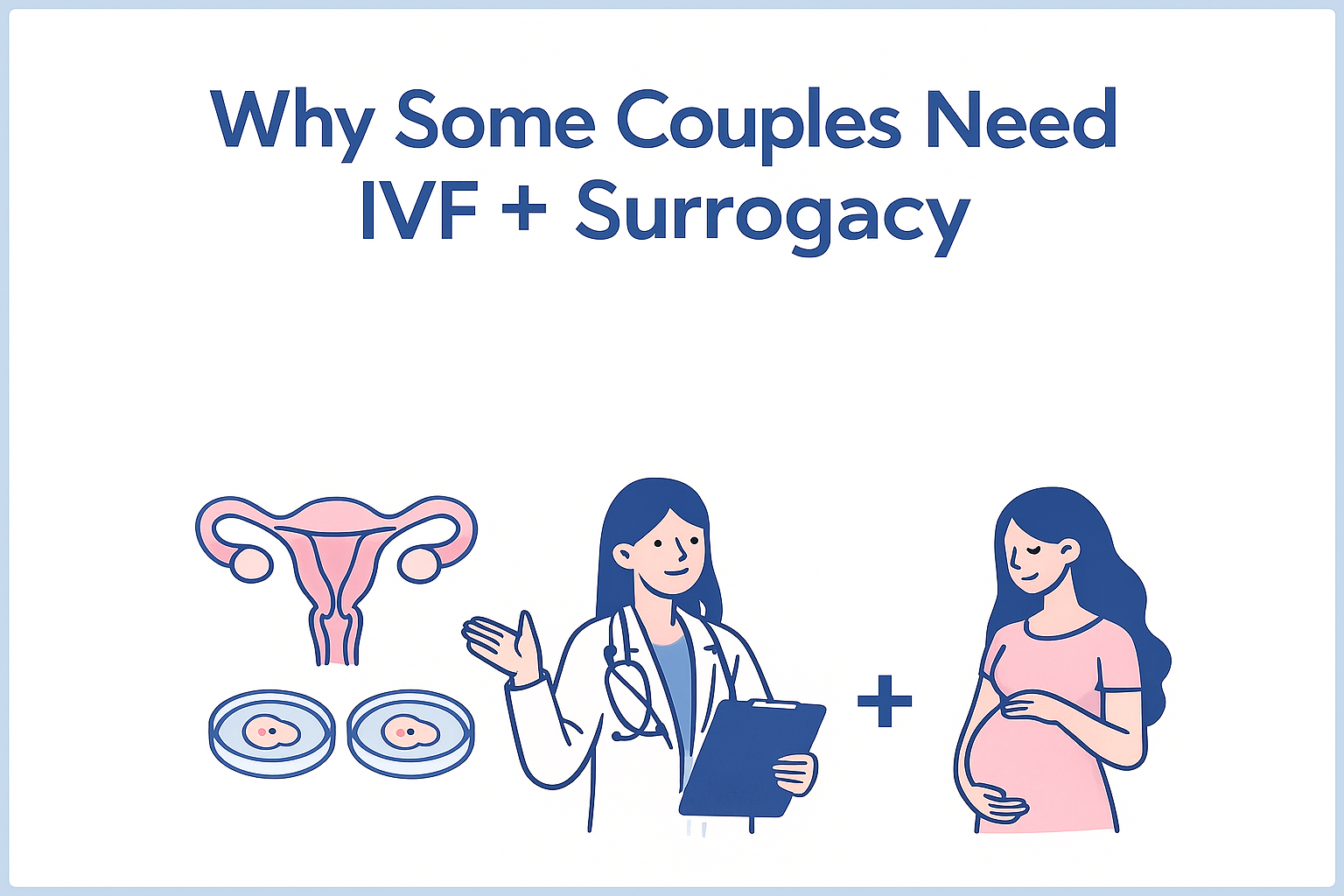
Some couples reach a point where IVF alone cannot solve the medical issues they face, and the safest way to achieve a pregnancy is through a surrogate. Clinics that handle both IVF and surrogacy under one system, such as SILK Medical in Georgia and Armenia, see this scenario every week. In these cases, combining the two methods follows the medical facts of the situation rather than the number of procedures involved.
Many patients arrive thinking surrogacy itself produces the pregnancy. In practice, surrogacy is only the pregnancy stage. The embryos still need to be created first, which is where IVF enters the picture.
When IVF alone cannot solve the problem
For some women, strong embryos simply cannot implant or develop because the uterus cannot support a pregnancy. This happens with severe adenomyosis, large or multiple fibroids that deform the cavity, repeated surgical trauma to the endometrium, untreated Asherman’s syndrome, or a developmental absence of the uterus.
The other category includes systemic conditions where pregnancy is unsafe for the patient: advanced cardiac disease, uncontrolled hypertension, clotting disorders, kidney failure, or complications after previous pregnancies. Even if the ovaries work well, carrying a pregnancy may pose a real risk. A surrogate removes that risk.
Medical histories where surrogacy becomes the safer choice
Some women go through several IVF cycles with good-quality embryos and still face repeated miscarriage or implantation failure. When these losses are linked to the uterine environment rather than embryo genetics, surrogacy becomes the next logical step.
Patients who have undergone major reproductive surgery, multiple myomectomies, or repeated dilation and curettage are often advised to avoid another pregnancy. The same applies to women who have had life-threatening complications like uterine rupture or severe preeclampsia.
These situations are frustrating, but they have a clear medical explanation. A surrogate simply provides the environment the patient no longer can.
Why IVF is still required before surrogacy
Surrogacy requires embryos, and embryos come from IVF. Even when patients already have frozen embryos, there are cases where another IVF cycle is necessary:
- embryos were created years earlier,
• no genetic testing was done,
• only one or two embryos remain,
• the couple now needs donor eggs.
IVF is the “engine” of the surrogacy process. The surrogate carries the pregnancy, but the embryo creation still relies on the intended parents’ or donor gametes.
When donor eggs and surrogacy are both needed
Women in their forties often face two parallel problems: low ovarian reserve and poor egg quality. Even with a healthy surrogate, embryos must still be chromosomally normal to result in a pregnancy. This is why many intended mothers 40+ end up combining donor eggs with surrogacy.
Donor-egg surrogacy is a common solution for women with low ovarian reserve or poor egg quality. High-quality donor eggs create stronger embryos, and the surrogate provides the conditions needed for pregnancy to develop safely.
Why PGT-A matters even when using a surrogate
A surrogate can carry a pregnancy, but she cannot compensate for chromosomal abnormalities in embryos. PGT-A reduces the number of failed transfers and lowers the chance of miscarriages, which is especially important for patients who have already spent years in treatment.
SILK’s IVF programs include PGT-A for up to five embryos as part of the standard package for many cycles, which shortens the time to a successful transfer and avoids unnecessary delays.
Georgia and Armenia: eligibility affects the path
One part of the decision has nothing to do with medicine and everything to do with law.
Georgia accepts only heterosexual married couples or couples who can prove at least one year of cohabitation. Armenia accepts single women and single men, which opens the door for patients who are not eligible in Georgia.
For couples who qualify in both countries, the decision often comes down to convenience and travel. For those who do not meet Georgian requirements, Armenia becomes the natural solution.
How SILK connects IVF and surrogacy into a single workflow
A combined IVF + surrogacy plan works well only when everything is coordinated under one system. Clinics that handle both stages can manage stimulation, donor selection, embryo creation, PGT-A, surrogate screening, pregnancy monitoring, and final legal steps without sending patients between multiple institutions.
SILK’s structure was built exactly for this: IVF teams, donor programs, surrogacy coordination, pregnancy care, partner clinics abroad, and legal support all operate as a connected chain. This avoids gaps between stages and keeps the timeline efficient, especially important for patients who travel from abroad.
When couples already have frozen embryos
Patients often come with embryos created elsewhere. This is fully workable. In these cases, the surrogacy program starts with document verification, then embryo shipment, then surrogate matching. The only time a new IVF cycle is advised is when embryos are few in number, very old, or lack proper medical documentation.
Who usually needs the IVF + surrogacy combination
Three groups appear most often:
- women over 40 with reduced ovarian reserve,
• couples with repeated implantation failure or multiple miscarriages,
• women advised by cardiologists or oncologists not to carry a pregnancy.
In these situations, IVF and surrogacy work together as a single medical pathway rather than separate options. Clinics that can handle both stages within one workflow, including embryo creation, PGT-A, donor programs, surrogate matching, and full pregnancy care, keep the process predictable. SILK Medical follows exactly this structure across Georgia and Armenia, which helps patients move from treatment to birth without having to coordinate several institutions on their own.

 English