


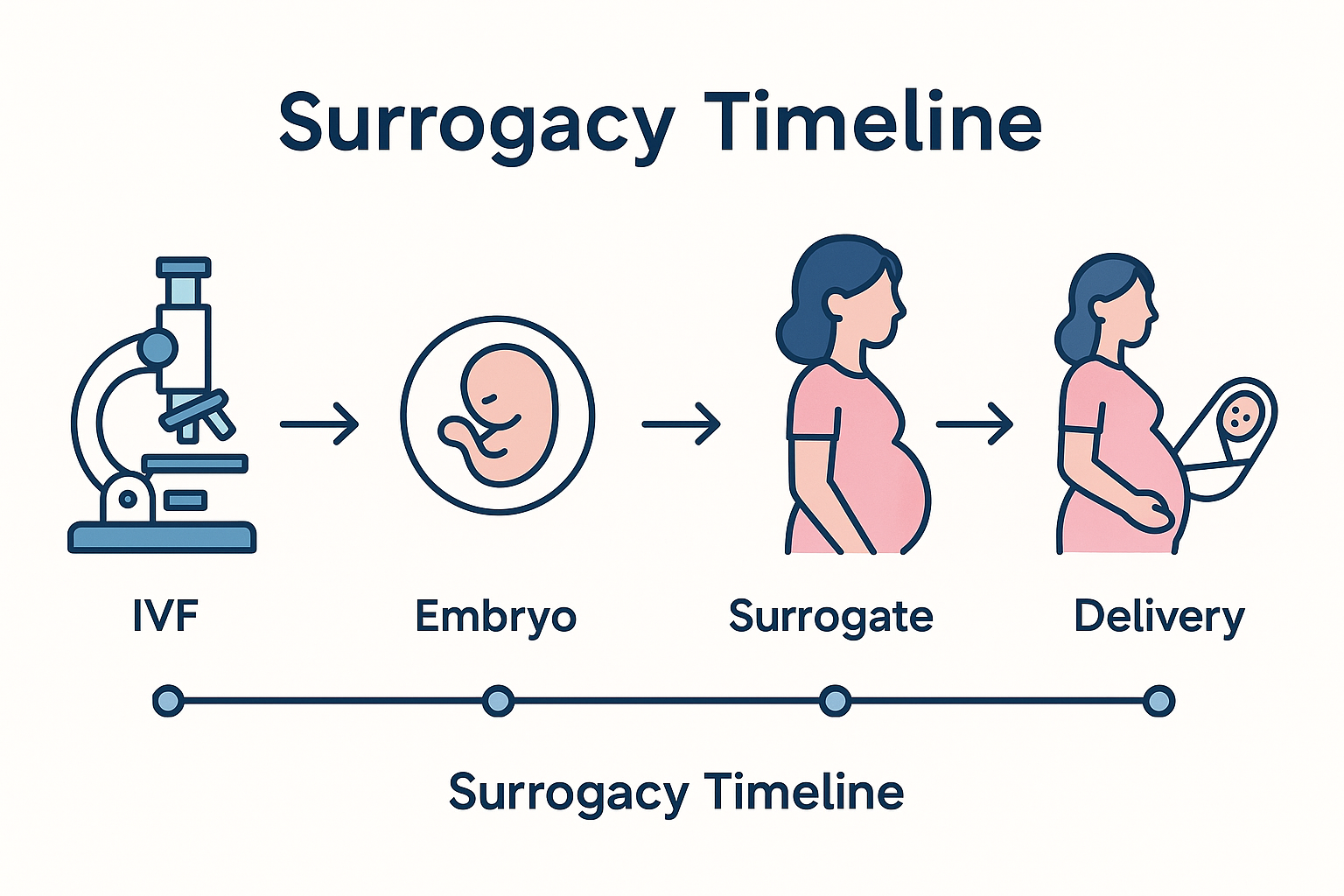
People often expect a quick answer to how long surrogacy takes. The truth is simple enough once the process is broken into stages. IVF creation, embryo testing, surrogate matching, pregnancy care, and post-birth paperwork each have their own rhythm. When combined, the timeline becomes predictable, especially in a clinic like SILK Medical, which handles hundreds of cases each year.
This guide walks through the full path for 2026, with timing differences for own eggs, donor eggs, shipped embryos, and programs completed in Georgia or Armenia.
IVF Creation With Your Own Eggs
When embryos are created in Tbilisi, the active medical phase usually lasts twelve to fourteen days. Stimulation begins on day two of the cycle and continues for about ten days. Monitoring happens throughout this period. When follicles reach the right size, the egg retrieval is scheduled.
After retrieval, fertilization and blastocyst development take place over the next five to six days. Embryos are then frozen. A biopsy sample from each blastocyst is sent for PGT-A, and results arrive roughly three weeks later.
The male partner’s role is straightforward. One or two sperm deposits, often spaced several days apart, are enough. Some couples choose to begin stimulation at home, which shortens the stay in Tbilisi, but the overall embryo-development timeline remains the same.
IVF Creation With Donor Eggs
Using donor eggs adds the step of selecting and screening the donor. When the donor is ready to begin stimulation, the cycle follows the same rhythm as any IVF cycle: stimulation, retrieval, fertilization, blastocyst development, biopsy, freezing, and PGT-A.
The only real variable is donor availability. Some donors can begin immediately. Others need a rest period if they recently completed a cycle. Once stimulation begins, the timeline matches the standard IVF pace.
Programs that include donor eggs (for example, Successful or Guaranteed) specify which medical steps fall inside the surrogacy package and which belong to the IVF creation stage.
Using Shipped Embryos: What the Timeline Really Looks Like
Parents who already have frozen embryos skip IVF creation, but this does not eliminate all waiting. The clinic that created the embryos must prepare several documents (which must be notarized and apostilled by the Intended Parents):
• the embryo creation certificate
• the freezing certificate
• the cryopreservation protocol
These documents must contain the fertilization date clearly at the top, along with signatures and stamps from the doctor and clinic director. They are later used for legal registration in Georgia, so accuracy is essential.
Another requirement is the infectious-disease screening done before the embryos were created. Both partners must have valid HIV, hepatitis B and C, and syphilis tests from that period. Tests taken afterward do not replace this requirement.
Organizing the documents, completing translations and apostilles, and arranging the shipping container usually takes two to four weeks in practice. Shipping itself may take another week or two, depending on the country.
Once embryos arrive and pass the internal documentation check, the surrogacy stage can begin without delay.
PGT-A Timing
PGT-A always adds approximately three weeks to the embryo-creation process. These weeks are fixed because the biopsy samples travel to a genetics laboratory, undergo analysis, and return with the chromosome report.
In other words, even a perfectly synchronized IVF cycle still includes this three-week window. Parents planning for 2026 should factor this in when estimating the earliest possible transfer date.
Surrogate Matching
Once embryos are ready and the medical file is complete, the next stage is matching with a surrogate. This part of the timeline usually runs in a predictable range. Most intended parents are matched within three months, which reflects the steady number of candidates coming through screening rather than fluctuations in demand. Some matching periods are shorter, usually when the medical requirements are straightforward and the intended parents are flexible regarding the surrogate’s profile. Others may take longer when additional criteria are introduced, such as specific age ranges or a preference for a surrogate who lives in a particular country.
The matching stage also includes medical assessments and a review of previous pregnancies, creating a reliable foundation for the transfer phase. When the medical review is complete, the program transitions directly into preparation for the embryo transfer without a significant pause.
Preparing the Surrogate for Transfer
After the match is confirmed, the surrogate begins the medical preparation needed for a frozen embryo transfer. This phase follows a structured protocol. The surrogate’s cycle is aligned with the medication regimen, and her endometrial response is monitored until the lining is ready for transfer. The process generally takes about three weeks, and the clinical timeline stays consistent regardless of whether the embryo was created through donor eggs, the intended mother’s eggs, or was shipped.
Once the lining meets the required parameters, the transfer is scheduled. The period between preparation and transfer is short, and the next monitoring point comes with the hCG test roughly two weeks later. When that result is positive, the first ultrasound for heartbeat confirmation is arranged around week six or seven. These steps follow the same rhythm in every program, which helps intended parents understand how close they are to the beginning of the pregnancy stage.
Pregnancy Care Until Week 40
Pregnancy care proceeds in a structured way once a heartbeat is confirmed. Some surrogates remain in Georgia throughout the pregnancy, while others travel home during the early trimesters and return to Tbilisi for the later stages. Both arrangements follow a coordinated plan that includes regular medical monitoring, communication with coordinators, and transportation or housing when needed.
Monthly evaluations continue until the surrogate returns to Georgia for the third trimester. This last stage is handled on site so that delivery planning, medical checks, and communication with the intended parents happen without interruptions. The overall sequence is steady, with few variables once the pregnancy is established.
Delivery and Birth Certificate Timing
Delivery takes place in one of the partner private hospitals in Tbilisi, where the surrogate remains for several days depending on the type of delivery and recovery speed. Immediately after birth, the paperwork for the Georgian birth certificate is prepared. Georgian law recognizes the intended parents as the legal parents from the moment of birth, which keeps this step efficient and predictable. On average it takes about one week to obtain the document.
After the Georgian birth certificate is issued, intended parents begin the passport and exit process at their embassy. Timelines differ significantly by country. Some embassies complete this step quickly (one- two weeks), while others require more time (up to a half a year). Families planning their stay in Tbilisi often coordinate their schedule around this final administrative phase.
Georgia and Armenia: Timeline Differences
Programs completed in Armenia follow the same medical rhythm as programs in Georgia. IVF creation, embryo culture, PGT-A, surrogate preparation, transfer, and pregnancy care proceed in the same order.
The distinction lies primarily in eligibility, since Armenian legislation accepts certain categories of intended parents who cannot enter programs under Georgian law. Administrative steps may vary slightly depending on the country issuing the final documents, but the medical and pregnancy timelines remain comparable. In addition, a DNA test to confirm the genetic link between the biological parents and baby is mandatory in Armenia to receive the birth certificate. In Georgia, this step is only required if an embassy requests it for the baby’s passport processing.
Summary of the Overall Timeline
When embryos are created through a fresh IVF cycle, the combined surrogacy timeline typically spans twelve to fourteen months. This includes stimulation, retrieval, fertilization, genetic testing, matching, transfer, pregnancy, and delivery.
Parents who arrive with PGT-A tested embryos usually move through the full sequence in nine to twelve months, depending on documentation readiness and matching speed. These ranges stay stable from year to year because the workflow is standardized and the medical steps follow a consistent order.
Planning for 2026
Intended parents who want a 2026 or early 2027 birth often begin preparing embryos at the start of the year or arrange the shipment during the same period. Once embryos are ready, the timeline settles into a clear structure: matching, preparation, transfer, pregnancy, delivery, and registration.
Programs run by SILK Medical follow this established flow, which makes it easier for families to plan travel, secure documents, and organize their schedules around each stage of the process.

 English