


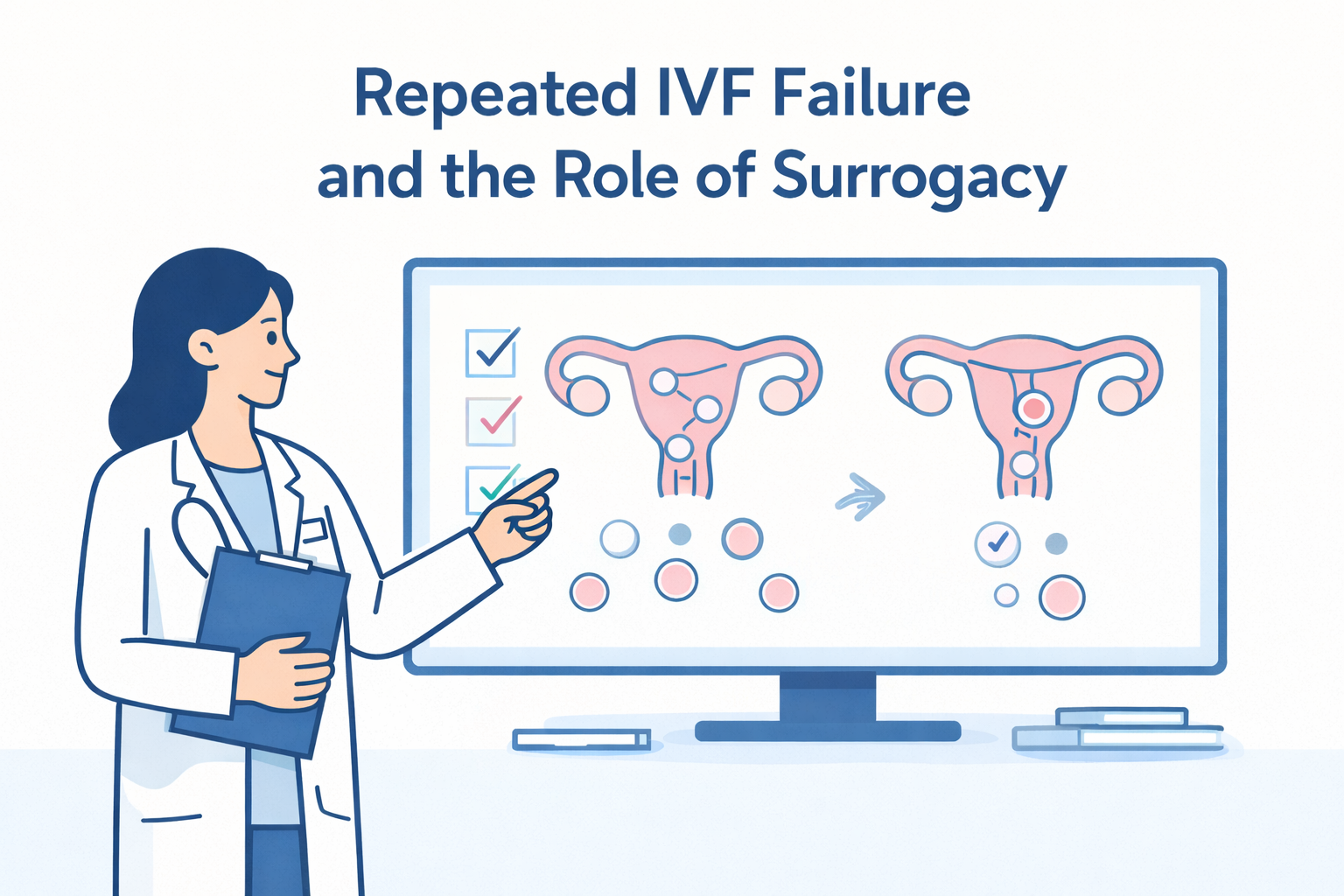
Repeated IVF failure is rarely the result of a single unsuccessful cycle. Most patients reach this point after several embryo transfers that appeared reasonable by standard medical criteria and still ended without implantation. The embryos were considered viable, the endometrium met thickness requirements, and the transfer itself followed accepted protocols. The outcome, however, stayed the same.
After two or three failed transfers, attention usually shifts away from the details of the last attempt. The more relevant question doctors at SILK Medical ask at this point is why repeated efforts lead to identical results, even when adjustments are made.
When failure follows a pattern
One failed transfer carries little diagnostic weight. Even two may fall within expected statistical variation. When implantation fails repeatedly under comparable conditions, randomness becomes a weak explanation. A pattern begins to form.
Clinically, this situation is often described as recurrent implantation failure. The term matters less than the implication behind it. At this stage, the limiting factor is usually no longer obvious or easily corrected. Repeating the same process with small technical changes often produces the same outcome because the underlying constraint remains unchanged.
Embryo quality reaches its explanatory limit
Embryo quality is the first variable examined in failed IVF cycles, and with good reason. Chromosomal abnormalities account for a large share of failed implantations, particularly in early attempts. Improving embryo selection helps many patients progress.
The problem arises once this step has already been addressed.
Transfers involving chromosomally normal embryos still fail in a subset of patients, sometimes repeatedly. When several euploid embryos do not implant, embryo quality alone can no longer explain the outcome. The focus has to move beyond the laboratory.
This is often where patients feel stalled. The embryos meet genetic criteria, the lab confirms proper development, and yet implantation does not occur.
Endometrial limitations that are difficult to measure
The uterus is commonly assessed through relatively simple markers. Endometrial thickness, visual structure, and the absence of major anatomical abnormalities help rule out severe issues. They do not confirm receptivity.
Subtle factors such as chronic inflammation, microscopic scarring, altered immune signaling, or impaired vascular response can interfere with implantation without producing clear findings on routine imaging. Some of these issues respond to treatment. Others persist despite repeated attempts with different medications and timing strategies.
As a result, protocol changes may alter measurable parameters without changing implantation outcomes. The uterus appears responsive, but remains functionally limited.
When implantation failure reflects systemic factors
Not all implantation problems originate within the uterus itself. Autoimmune conditions, clotting tendencies, metabolic disorders, and age-related systemic changes can all affect early pregnancy without being fully correctable.
In these cases, treatment often escalates gradually. Monitoring becomes more intensive. Additional medications are introduced. Despite this, outcomes remain unchanged because the biological ceiling has already been reached.
At this point, continued IVF with self-carry tends to fail for structural reasons rather than missed adjustments.
Why a change of clinic often changes little
Switching clinics after repeated failures is a common and understandable decision. A new medical team may offer different protocols, equipment, or interpretation of previous results.
Early in treatment history, this can make a difference. Later on, when the same embryos and the same uterus remain involved, the effect is usually limited. Variations in stimulation or transfer technique may help marginal cases, but they rarely overcome a persistent biological constraint.
When similar results occur across clinics, the explanation is typically feasibility rather than competence.
When surrogacy becomes a medical decision
Surrogacy is often framed as a last resort or an emotional turning point. From a medical perspective, it is a targeted intervention. Surrogacy removes one variable from the equation, namely the uterine environment.
For patients with repeated implantation failure, this change can significantly alter probabilities. The embryos remain the same. The laboratory process remains the same. What changes is the capacity to support implantation and early placentation.
This shift, however, does not eliminate all risks. Embryo quality continues to matter and genetic limitations remain relevant. What surrogacy offers is a higher likelihood of implantation when the uterus has become the limiting factor.
Timing plays an important role too. Patients who transition to surrogacy while viable embryos are still available often have more predictable outcomes than those who continue self-transfer until embryos are exhausted.
What improves when surrogacy is used
The primary change is consistency. A healthy, proven uterus reduces variability between transfers. In most cases, implantation rates stabilize and early pregnancy loss becomes less frequent. Outcomes depend more directly on embryo characteristics rather than uterine response.
A rational adjustment
Choosing surrogacy does not mean IVF was unsuccessful. In many cases, IVF achieved its core objective, which is the creation of embryos, their development, and preimplantation genetic testing. The remaining obstacle was implantation.
For patients in this position, surrogacy represents a logical adjustment to a documented limitation rather than an emotional turning point. Cases of this kind are reviewed regularly at SILK Medical. Decisions are based on the full treatment history, including the number of transfers, embryo genetics, uterine response over time, and relevant systemic factors.
A key understanding here is that surrogacy does not promise outcomes. Instead, the programs can change probability in situations where repeated IVF has reached its natural limit. For many patients, that change is sufficient to finally move forward.

 English