


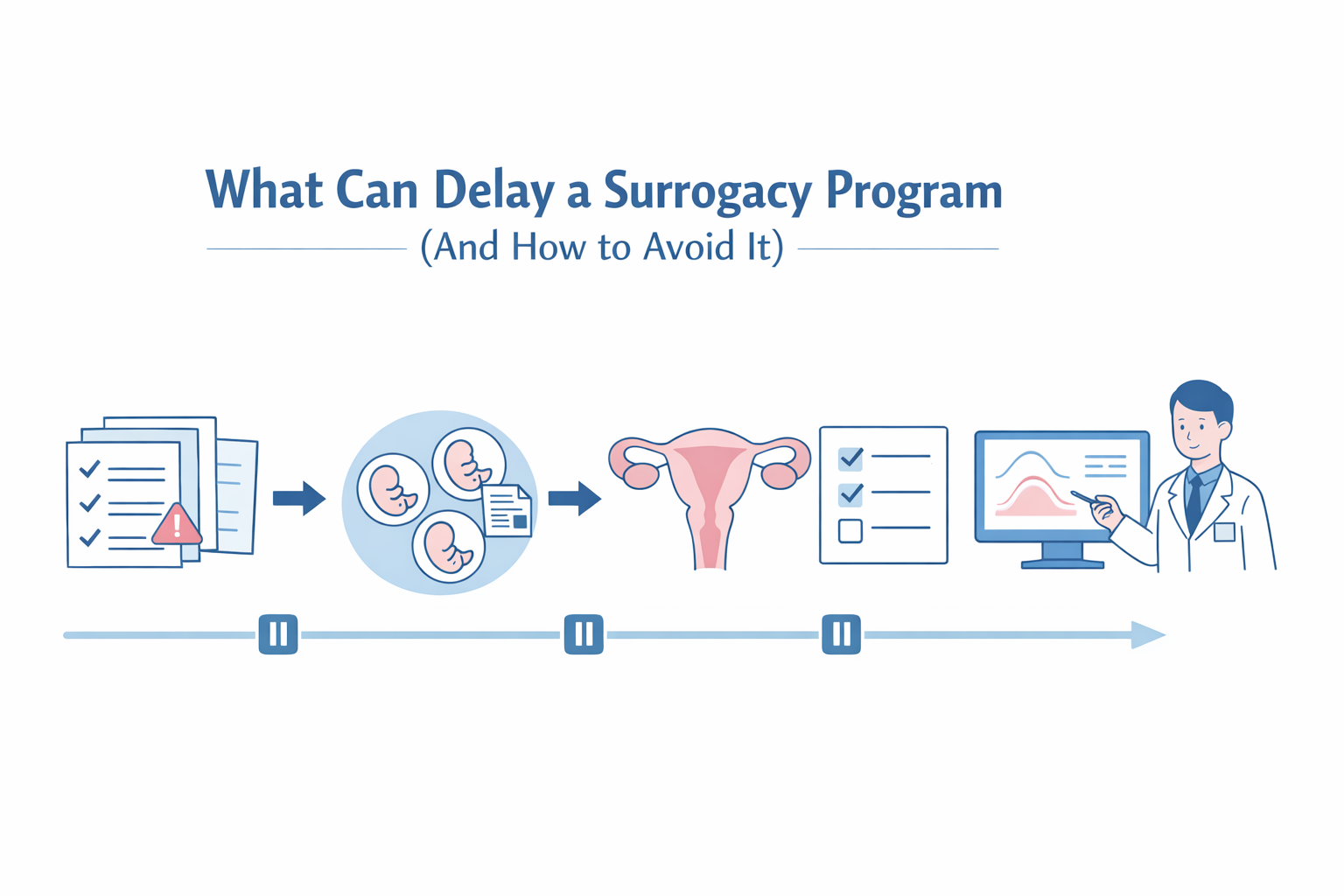
Surrogacy programs rarely move in a perfectly straight line. Even when the medical part is well planned, timelines can stretch for reasons that have little to do with treatment itself. Documents may take longer to prepare than expected. Embryo paperwork can raise questions late in the process. A surrogate match that looks ideal on paper may simply take time to appear. None of this is unusual for the SILK Medical team, but it often catches intended parents off guard.
Most delays in surrogacy follow clear patterns. They tend to happen at the same stages, for the same reasons, across different countries and clinics. Understanding where these slowdowns usually occur helps reduce frustration and prevents unrealistic expectations at the start. Let’s take a look at the most common causes of delays in surrogacy programs and explain what can be done early on to keep the process moving without unnecessary pauses.
Documents not ready
Most surrogacy delays start long before any medical step takes place. Legal documents are often treated as a formality, when in practice they set the pace for the entire program.
The most common issues involve marriage certificates or proof of cohabitation. Originals are missing. Apostilles are added to copies instead of originals. Translations are done after notarization, which makes them unusable. Names or passport numbers do not match current documents. Sometimes the document itself is valid, but the dates do not meet the local legal requirement.
These problems usually surface only when contracts are about to be signed, which means the program pauses while everything is corrected.
How to avoid it is simple in theory, but requires discipline. Documents should be prepared early and reviewed before notarization and apostille. Scans sent for confirmation save weeks later. When paperwork is treated as a parallel process rather than a last step, timelines become far more predictable.
Embryo paperwork issues
Programs that use existing or shipped embryos add another layer where delays are common. The embryos themselves may be perfectly viable, but the documentation surrounding them often is not.
Typical problems include missing embryo creation certificates, incorrect or absent fertilization dates, documents signed by a doctor but not the clinic director, or certificates that were issued months or years after the actual procedure without proper dating. Infectious disease screening is another frequent issue. Tests must match the timing of embryo creation, not the present day, and this detail is often overlooked.
When these gaps are discovered late, embryo shipment or transfer has to be postponed while clinics and notaries attempt to reconstruct records from the past.
The most effective way to avoid this is early document review. Clinics like SILK Medical, which regularly work with international embryos, usually provide templates and clear requirements upfront. Sending draft documents for review before apostille and shipment prevents rework. In some cases, creating embryos locally simplifies the entire process by keeping medical and legal documentation under one roof.
Surrogate matching expectations
Surrogate matching is another area where expectations can quietly extend timelines. Many intended parents begin with a very specific image of the ideal surrogate. Narrow age ranges, a first-attempt successful pregnancy history, no prior C-sections, immediate availability, and full relocation are all reasonable preferences on their own. Taken together, they significantly reduce the pool of candidates and stretch the wait times.
Matching slows further when all preferences are treated as non-negotiable requirements. In reality, some criteria affect medical outcomes, while others affect comfort or peace of mind. Mixing these categories makes it harder to move forward.
Programs tend to progress faster when priorities are clearly ranked. Understanding which factors truly influence success allows flexibility in areas that do not. Clinics usually raise these points early not to lower standards, but to keep matching timelines realistic.
Medical surprises
Even well prepared programs can pause due to medical findings that appear mid-process. Donors may develop temporary ovarian cysts. Hormone responses may differ from expectations. Additional screening may be needed after initial results are reviewed. In surrogacy cycles, endometrial readiness does not always align with the planned transfer window.
These pauses are frustrating, but they are usually protective rather than corrective. Proceeding without addressing them often leads to failed transfers or lost embryos, which creates much longer delays later.
The practical way to reduce disruption is early screening and built-in buffer time. Backup donors and alternative timelines are not signs of pessimism. They are part of risk management in complex reproductive programs.
Embassy and exit paperwork delays
After birth, timelines are often influenced by embassy and passport procedures. Requirements vary widely by country. Some embassies request DNA confirmation. Others focus on document translation, legalization, or local registration steps. Processing times can range from days to months.
These delays are rarely caused by mistakes. They are usually the result of fixed administrative procedures outside the clinic’s control.
Programs move more smoothly when exit requirements are discussed before delivery, not after. Knowing what documents will be needed allows clinics to prepare files in parallel instead of reactively.
How delays usually play out in real life
Delays in surrogacy programs are usually not random. They follow familiar patterns related to documents, matching, medical timing, and post-birth administration. Clinics like SILK Medical, which flag potential issues early, are simply doing their job of preventing longer pauses later.
When expectations are realistic and preparation starts early, most programs move forward steadily, even if the timeline adjusts along the way.

 English