


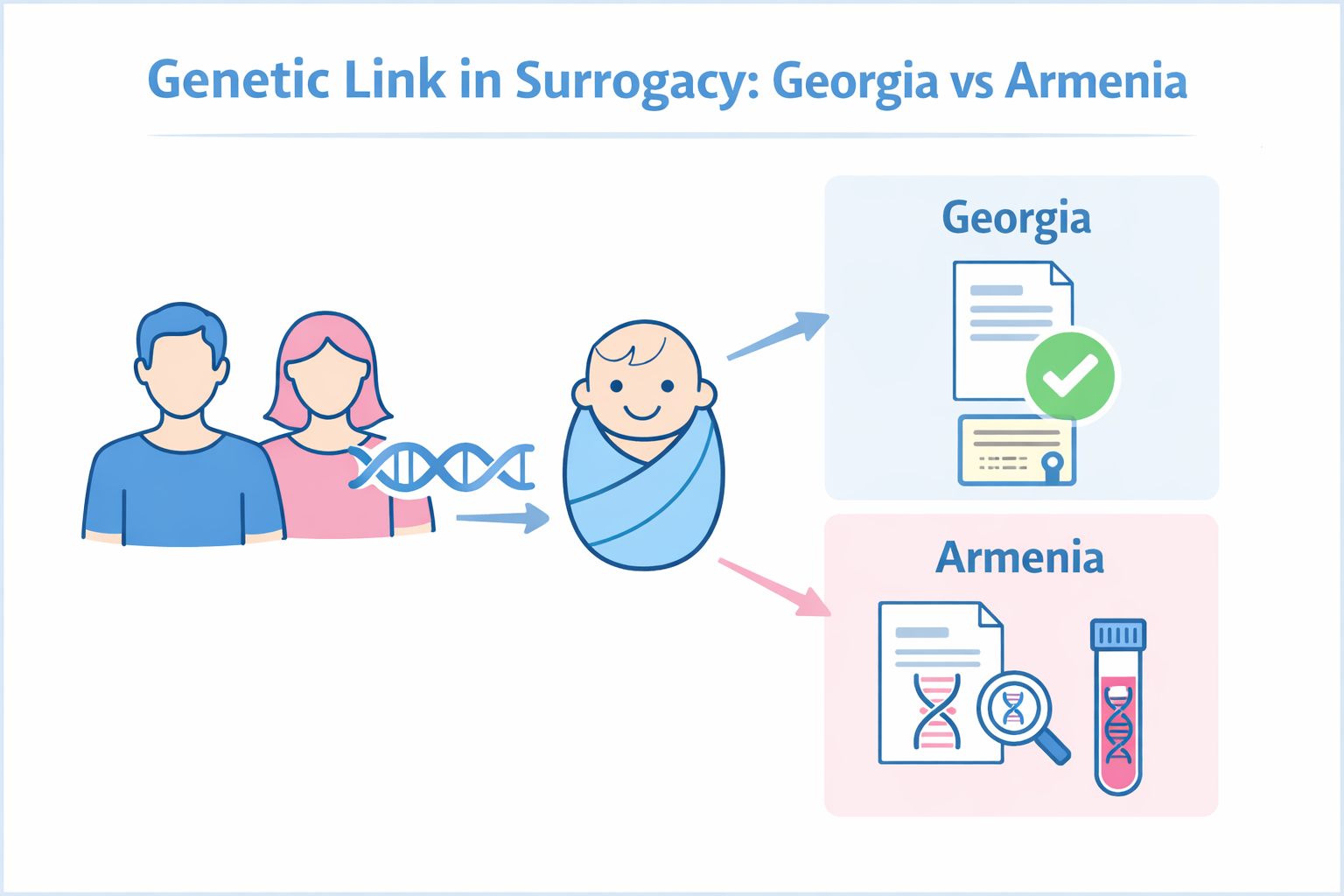
When people first consider IVF or surrogacy, they usually focus on medical success rates, timelines, and costs. The question of genetic connection often comes later. At some point, almost every couple or single intended parent asks the same thing: what happens if only one of us is biologically related to the child?
This situation is common in modern fertility treatment. A husband may use donor eggs. A wife may use donor sperm. Some couples rely on donor embryos. Single intended parents may combine their own genetic material with a donor. Medically, these are standard pathways. Legally, however, the answer depends on where the program takes place and how local legislation defines parenthood.
These distinctions are especially relevant for intended parents considering programs in Georgia and Armenia through SILK Medical, where IVF and surrogacy are structured under two different legal systems. The medical plan must align with local legislation as well as embassy requirements in the parents’ home country.
Let’s examine how genetic link requirements work in Georgia and Armenia, when DNA testing becomes relevant, and what intended parents should realistically expect when only one partner is genetically related.
Georgia. What Does the Law Require?
Surrogacy is legal in Georgia. Intended parents are recognized as the legal parents from the moment of birth, and the surrogate mother has no parental rights. The birth certificate is issued directly in the names of the intended parents. No court order is required.
Genetic connection is not mandatory for both parents under Georgian legislation. A program may proceed if only one intended parent is biologically related to the child. This applies to common scenarios such as donor egg with husband’s sperm or donor sperm with wife’s eggs.
There is, however, an important legal detail when donor material is involved. Anonymous donors cannot be used in surrogacy programs under Georgian legislation. The clinic must have full donor identification and a Power of Attorney from the donor used in the program. Proper contractual documentation is required.
This becomes particularly relevant for couples who created embryos abroad using anonymous sperm or egg banks. In many cases, those embryos cannot be transferred into a Georgian surrogacy program unless donor identity and POA requirements are satisfied.
From a birth registration standpoint, the process is straightforward. The child is registered in the names of the intended parents. The surrogate is not listed on the birth certificate.
The complexity often arises later, during the exit process. Some embassies require a DNA genetic link test with at least one of the parents before issuing a passport or travel documents. In donor egg programs, this is typically a test between the father and the child. In donor sperm programs, it may be a test between the mother and the child.
This requirement does not come from Georgian law. It comes from the embassy of the parents’ country of citizenship. Planning for this step in advance helps avoid delays after delivery.
Armenia. When Genetic Link Becomes Legally Critical
Armenia allows surrogacy for married couples and for single intended parents, including foreign citizens. However, the role of genetic connection is more restrictive than in Georgia.
For single intended parents, a biological link is mandatory. A single man must use his own sperm. A single woman must use her own eggs. A donor embryo without any genetic link to the intended parent is not permitted in a single-parent surrogacy program.
There is also a frequent misunderstanding that needs to be addressed clearly. A legally married person cannot apply as a “single” parent, even if the spouse agrees to stay uninvolved. Armenian authorities require formal proof of single status. This document must be translated, notarized, and apostilled.
If a person is legally married, Armenian law treats them as married for the purposes of assisted reproductive technologies. Spousal consent does not convert a married person into a single applicant.
At birth registration in Armenia, documentation includes confirmation that the surrogate is not the biological mother. DNA confirmation is a part of the contractual and administrative process, particularly when required by authorities or embassies.
Because at least one intended parent must be biologically related in many Armenian surrogacy structures, genetic link is a legal requirement.
DNA Test After Surrogacy. Who Actually Requires It?
Many intended parents assume that if local law recognizes them as parents, no further testing will be required. In practice, embassies frequently apply their own standards.
For passport issuance and exit documents, some countries require proof that the child has a genetic link to at least one parent. This is especially common in donor egg programs, where the father’s DNA is used to establish biological connection.
The DNA test is performed after birth. It is arranged through accredited laboratories, and results are submitted to the relevant embassy. The timeline for exit can depend on how quickly this step is completed. This requirement reflects how different countries regulate citizenship transmission.
What Happens at Birth Registration?
In Georgia, the process is administrative. After delivery, the birth certificate is issued in the names of the intended parents. The surrogate’s name does not appear as the mother. There is no adoption procedure and no court hearing.
In Armenia, documentation includes confirmation that the surrogate is not genetically related to the child. A DNA test is performed in order to obtain the birth certificate itself by a local lab. During the exit process, a relevant embassy might request an additional DNA test from an internationally certified lab for final documentation.
In both countries, the clinic provides legal support for paperwork, translation, and notarization as part of the surrogacy structure. The focus is on securing clear parentage from day one so that the exit process can proceed smoothly.
Family Dynamics When Only One Parent Is Genetically Related
Questions about bonding often surface during consultations. Some parents worry that the absence of a genetic link for one partner may affect attachment or family dynamics.
Research and long-term observation of donor-conceived families show that parental role, daily caregiving, and emotional presence shape the parent-child relationship far more than DNA alone. Legal recognition from birth also supports a stable framework for the family.
In practice, families formed through donor eggs, donor sperm, or donor embryos function like any other family. The clarity of the legal process and openness within the family structure tend to matter more than the distribution of genetic material.
How Each Scenario Is Handled in Practice
Donor egg + husband sperm
Georgia: allowed. Birth certificate in both parents’ names. Embassy may require father-child DNA test.
Armenia: allowed. Biological link to father required in single male cases.
Donor sperm + wife egg
Georgia: allowed. Birth certificate in both parents’ names. Embassy may require mother-child DNA test.
Armenia: allowed if mother is biologically related.
Donor embryo
Georgia: possible for married couples, subject to donor identification, POA compliance and embassy requirements for DNA genetic link test.
Armenia: generally restricted if no intended parent has biological link, especially in single-parent cases.
Single man + donor egg
Georgia: not permitted under local surrogacy framework.
Armenia: permitted if he is the biological father and provides proof of single status.
Single woman + donor sperm
Georgia: not permitted under local surrogacy framework.
Armenia: permitted if she uses her own eggs and provides proof of single status.
Intended parents can choose the right jurisdiction from the beginning if they understand how genetic link requirements work in Georgia and Armenia. SILK Medical coordinates IVF and surrogacy programs in Tbilisi and Yerevan, and helps intended parents structure their program correctly from the start, including donor compliance, genetic link considerations, and post-birth documentation planning.

 English