


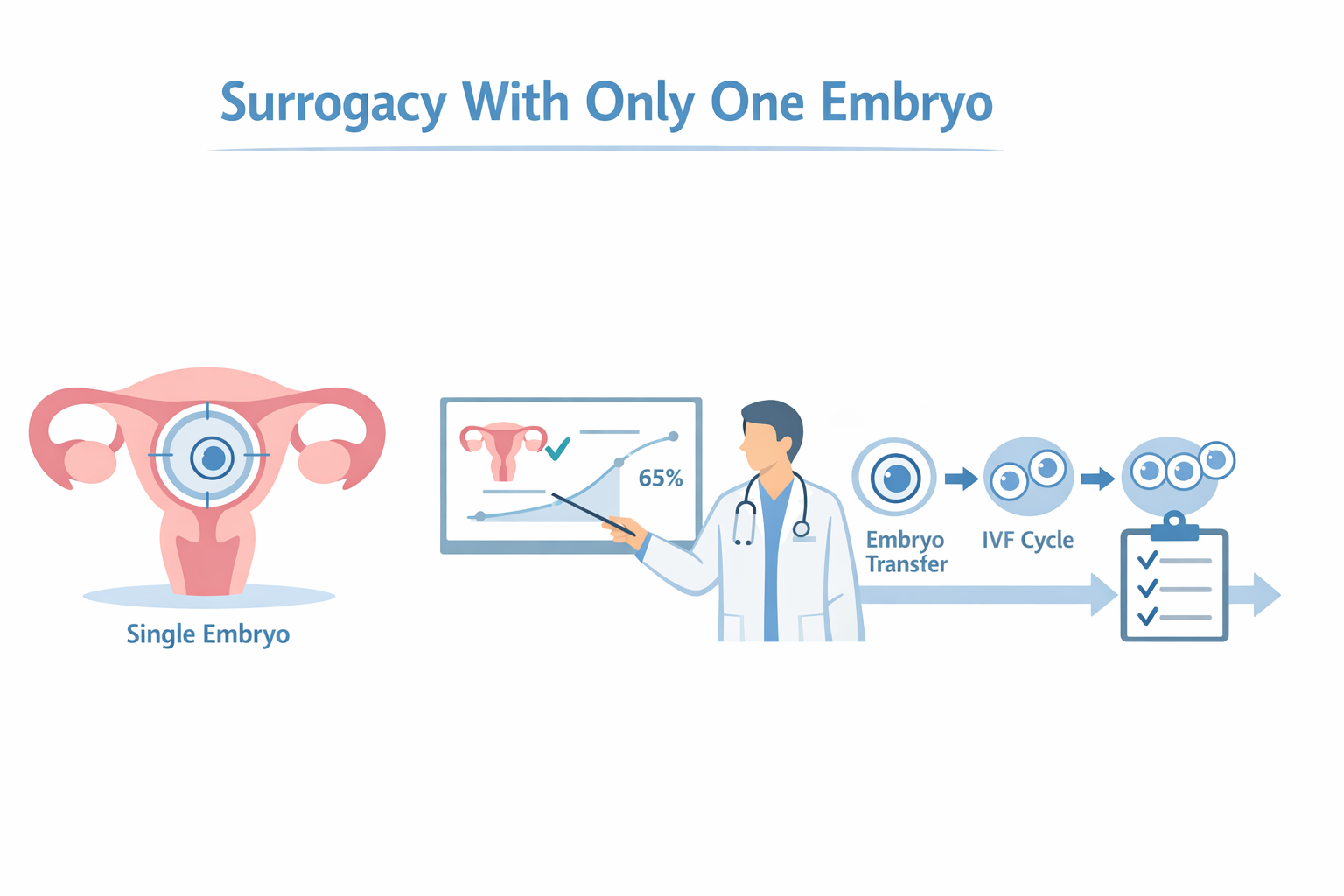
For some intended parents, surrogacy planning begins at a stage when only one viable embryo is available for transfer. This often happens after earlier IVF cycles produced limited results or when treatment was started later in reproductive life. In clinical practice at SILK Medical, such cases are common and require careful timing and realistic expectations. A single embryo can still lead to a successful pregnancy, but it also changes how doctors and patients approach program structure, financial planning, and decisions about whether to create additional embryos before proceeding.
What are the real chances with a single embryo
Even a genetically tested blastocyst does not lead to pregnancy in every case. Implantation depends on multiple factors. These include embryo genetics, laboratory conditions during culture and freezing, and how well the uterine lining responds to preparation.
Surrogacy improves the uterine factor by transferring the embryo to a medically screened carrier. However, this does not remove biological uncertainty. A single transfer may succeed on the first attempt. It may also require another cycle if implantation does not occur or if pregnancy stops developing early.
This is why fertility teams usually discuss probability in terms of cumulative success rather than one specific transfer. National assisted reproductive technology statistics from the U.S. Centers for Disease Control and Prevention also present IVF outcomes in terms of cumulative success across multiple embryo transfer attempts, rather than a single procedure.
Why many surrogacy programs include more than one transfer
Program structure in modern surrogacy is based on medical statistics rather than simple procedure costs. Multiple transfer attempts are included because this approach reflects how pregnancy success is usually achieved in real clinical timelines.
For intended parents who already have embryos, structured options typically include either a single-transfer program or a program that allows several attempts. For example, a one-transfer model may be suitable when another IVF cycle is already planned. A multi-transfer structure allows more flexibility if the outcome of the first attempt is uncertain or if embryo creation is medically complex. Programs designed around shipped or previously created embryos often follow this logic.
In real cases, this usually becomes a budgeting decision rather than a medical debate. Some couples prefer to secure several transfer attempts within one structured program. Others accept the risk of starting with a single transfer and plan to reassess after the outcome. Both approaches are used in practice. The right choice depends on how difficult embryo creation was in the past and how quickly another IVF cycle could realistically be organized.
When it makes sense to create additional embryos first
Proceeding with surrogacy immediately is not always the most strategic option. In some cases, doctors may recommend creating more embryos before starting the program. This approach is often considered when
– the patient’s age suggests declining ovarian reserve
– previous embryo development results were inconsistent
– genetic testing left only one transferable embryo
– there is a desire to plan for more than one child in the future
An additional IVF cycle may improve overall cumulative success rates by increasing the number of transfer opportunities. Embryo creation programs at SILK Medical typically include stimulation medication, fertilization procedures, genetic testing for several embryos, and freezing for later use.
From a long-term perspective, having more embryos available often reduces pressure on the first surrogacy attempt and allows more structured planning.
Choosing program type when only one embryo exists
When a single embryo is already frozen and ready for transfer, program selection becomes a practical decision about risk distribution.
A single-transfer surrogacy program may be appropriate if the intended parents are prepared to return for another IVF cycle soon after the first attempt if needed. This approach can reduce initial costs and shorten timelines.
A multi-transfer program may be more suitable when embryo creation is difficult or when travel logistics make repeated treatment cycles complicated. In this case, the program structure provides additional transfer opportunities within the same overall framework.
For example, patients who live far from Georgia or have strict work schedules often lean toward programs with more transfer attempts included. Those who are already planning another IVF cycle within a few months may see little advantage in paying for additional attempts upfront. In consultations, this discussion usually comes down to timeline logistics rather than purely medical factors.
Planning beyond the first transfer
Surrogacy with only one embryo should always be approached with a clear contingency plan. This plan usually includes
– a defined timeline for reassessment after transfer
– medical criteria for deciding on a new IVF cycle
– financial planning for additional treatment
– consideration of donor options if embryo quality remains limited
Clinics normally recommend deciding in advance how long to wait before repeating IVF if implantation does not occur. Some patients choose to start preparation for a new cycle immediately after a negative hCG result. Others prefer to wait several months to recover physically or financially.
A structured approach leads to better decisions
Current internal statistics at SILK Medical show that the probability of pregnancy after the first embryo transfer in surrogacy programs is usually around 65 percent. This figure may vary depending on embryo genetics, the age at which the embryo was created, and previous reproductive history.
Having only one embryo does not mean that surrogacy success is unlikely. Many pregnancies begin from a single well-developed blastocyst. The key factor is how the overall treatment strategy is built around realistic medical probability.
Many successful surrogacy cases begin with limited embryo numbers. What often makes the difference is how quickly the treatment plan can adapt if the first attempt does not lead to pregnancy. Programs that combine medical flexibility with realistic scheduling tend to produce more stable long-term outcomes.

 English