


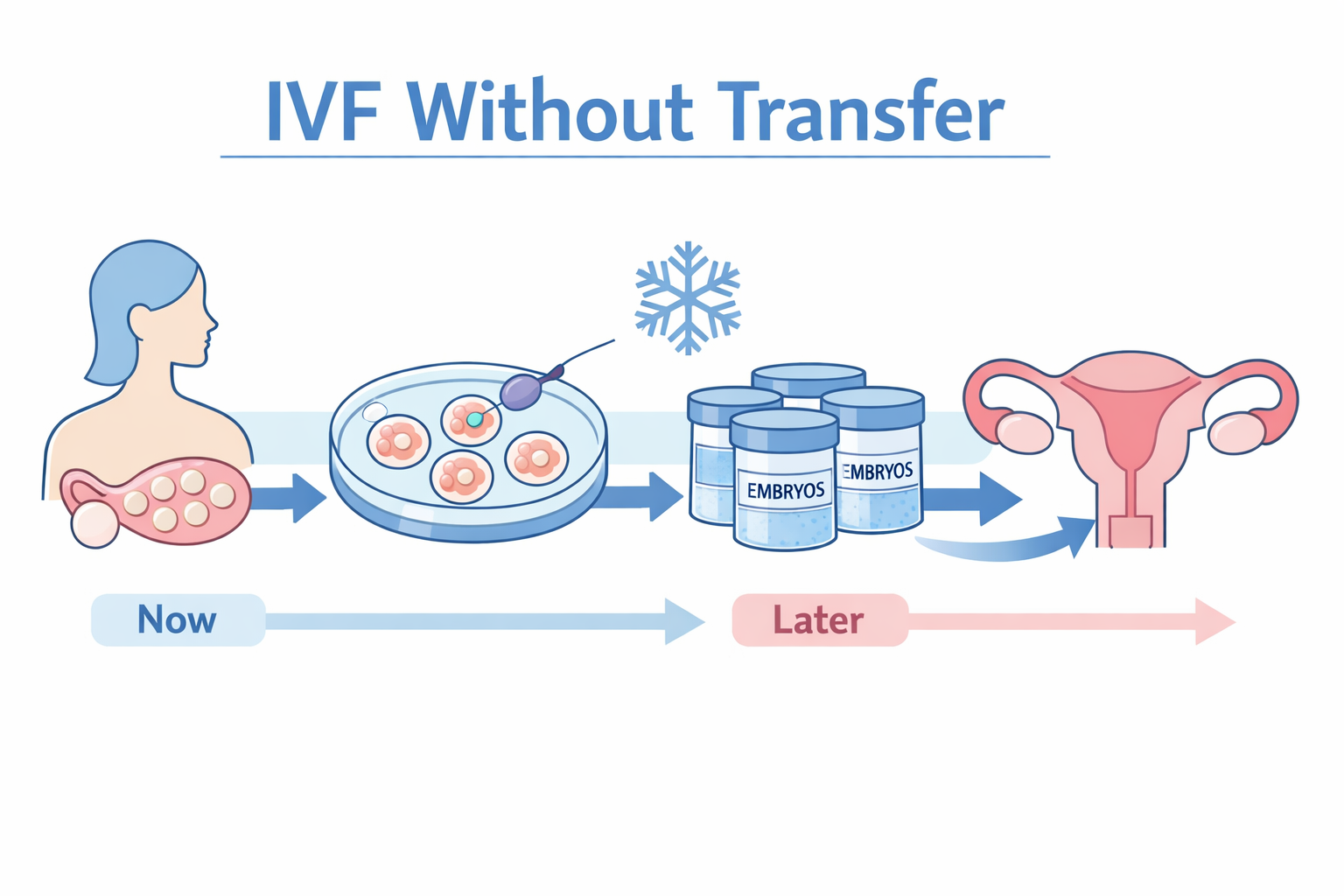
A growing number of SILK Medical patients choose to separate embryo creation from embryo transfer, completing IVF first and freezing embryos for use at a later stage. This approach is often part of a longer plan, especially when surrogacy is being considered but cannot begin immediately due to medical, legal, or personal timing.
Instead of rushing into a full treatment cycle, patients create and test embryos in advance, secure them through cryopreservation, and return to the process when the conditions are right. This structure changes how IVF is used. It becomes a preparation step rather than a single continuous procedure, giving patients more control over timing, costs, and next decisions.
What IVF Without Transfer Actually Means
In a standard IVF cycle, embryo transfer follows a few days after genetic test results are ready. In this case, the process stops earlier. Eggs are retrieved, fertilized, and cultured to the blastocyst stage. The embryos are then tested if needed and frozen instead of being transferred.
This is often called a freeze-all approach. All viable embryos are stored and can be used later, either for the intended mother or for a surrogate. The medical part of IVF is completed in full, but the pregnancy stage is postponed.
This process at SILK Medical typically includes stimulation, egg retrieval, fertilization with ICSI, embryo culture, PGT-A testing for up to five embryos, and vitrification for storage . The embryos remain stable in storage for years, with no loss of quality over time.
When It Makes Sense to Freeze Embryos First
This approach is usually chosen when timing does not align with immediate transfer.
One common reason is medical. A patient may not be able to carry a pregnancy safely, or the uterine environment may not be optimal at the time of IVF. Instead of delaying everything, embryos are created and preserved.
Another reason is legal or logistical. Surrogacy programs sometimes may require documentation, approvals, or coordination that can take several months. Creating embryos in advance allows patients to move forward with the next stage without waiting for another IVF cycle.
There is also a practical side. Some patients simply want to separate the process into stages. IVF is completed first, results are clear, and decisions about transfer or surrogacy are made afterward.
Why Some Couples Create Embryos Years Before Surrogacy
In many cases, this is about timing and biology.
Egg quality is closely linked to age. Creating embryos earlier can improve the chances of having viable, genetically normal embryos available later. This is especially relevant for patients who are not ready to proceed with surrogacy immediately but want to preserve their current reproductive potential.
There are also situations where surrogacy is planned but delayed. This can be due to legal restrictions in the patient’s country, financial planning, or personal circumstances. Instead of waiting and risking lower IVF outcomes later, embryos are created and stored in advance.
Some patients complete IVF, freeze embryos, and only return to the program years later when they are ready to move forward.
Timeline – From IVF to Future Surrogacy
The IVF stage itself is relatively short.
Stimulation and monitoring take around 10 to 12 days. Egg retrieval follows, and embryos are cultured for 5 to 6 days. If genetic testing is included, results are usually ready within about three weeks.
At that point, embryos are frozen and stored.
The gap between IVF and surrogacy can vary widely. Some patients proceed within a few weeks or months. Others wait years.
When the patient decides to move forward, the next stage begins. Surrogate matching typically takes up to three months, depending on requirements. Once a surrogate is selected and prepared, the embryo transfer can be scheduled.
Because embryos are already available, there is no need to repeat IVF. This shortens the active timeline of the surrogacy program.
Cost Comparison — Georgia vs US
One of the main reasons patients choose this structure is cost control.
A full IVF cycle with embryo creation, PGT-A testing, freezing, and medications at SILK Medical is around $7,000 . This covers the entire medical process up to embryo storage.
In the United States, the same process often costs two to three times more, especially when medications and genetic testing are included. On top of that, patients who create embryos locally and then ship them abroad typically spend around $4,000 on transport alone.
When IVF is done in Tbilisi, even with travel and accommodation, the total cost is usually lower than completing IVF in the US and shipping embryos later.
Split Payment Option
For patients who prefer flexibility, IVF without transfer can also be structured with split payments.
The first part is paid before egg retrieval and covers examinations, stimulation, medications, the procedure itself and the genetic testing. The second part is paid after results are known and depends on the number of embryos that are cultured, tested, and frozen.
This approach allows patients to adjust their costs based on actual results. If fewer embryos are created, the second stage cost is lower. It also reduces the upfront financial pressure compared to paying for the full package at once.
Delayed Motherhood Program – Where It Fits
For some patients, the process starts even earlier with egg freezing.
SILK Medical’s Delayed Motherhood Program allows women to preserve their eggs before creating embryos. The procedure includes stimulation, egg retrieval, and cryopreservation, with the option to use these eggs later for IVF.
This is often chosen by patients who are not yet ready to decide on a partner, IVF, or surrogacy, but want to preserve fertility at a younger age. When the time comes, the frozen eggs can be fertilized and developed into embryos, which can then be used for transfer or surrogacy.
In practical terms, this creates a three-step structure. Eggs are frozen first. Embryos are created later. Transfer happens when the patient is ready.
How This Connects to Surrogacy Programs
Once embryos are created and stored, the surrogacy process becomes more straightforward.
Programs designed for patients with ready embryos, such as SILK Medical’s $43,000 option, focusing on surrogate matching, pregnancy management, and delivery rather than IVF. Since the embryos are already available, the program can begin without delays related to stimulation or retrieval.
This also reduces uncertainty. Patients already know how many embryos they have and whether they are genetically tested. The focus shifts from embryo creation to achieving a successful pregnancy.
Planning Ahead Changes the Process
Separating IVF from embryo transfer changes how patients approach treatment. Instead of making all decisions at once, the process is broken into stages that can be managed over time.
For some, this removes time pressure. For others, it improves medical outcomes by allowing earlier embryo creation. In surrogacy cases, it also makes the later stages more predictable, since one of the key variables is already resolved.
The structure offered by SILK Medical is becoming more common as patients look for ways to plan treatment more deliberately, rather than fitting everything into a single cycle.

 English