


Georgia keeps coming up in conversations about surrogacy for a reason. The legal framework has stayed stable for years, costs are lower than in the US or Western Europe, and the process is relatively straightforward for international patients.
Clinics like SILK Medical in Tbilisi work with couples from all over the world who are trying to understand one basic question before they go any further. Is surrogacy actually legal here, and what does that mean in practice for foreign parents in 2026.
The short answer is yes. Surrogacy is legal in Georgia, including for foreign couples, and the core legislation that allows it has not changed. That said, the details matter more than the headline. Who qualifies, how parenthood is assigned, what documents are required, and how the process works on the ground can all affect whether Georgia is the right option.
Is Surrogacy Legal in Georgia in 2026
Yes, surrogacy is legal in Georgia in 2026, including for foreign couples. The legal framework has been in place since the 1990s and continues to allow both gestational surrogacy and the use of donor eggs or sperm. There have been public discussions about possible restrictions in recent years, but no legal changes have been implemented. Programs continue to operate under the same rules.
Who Can Access Surrogacy in Georgia
Eligibility is one of the first things to check.
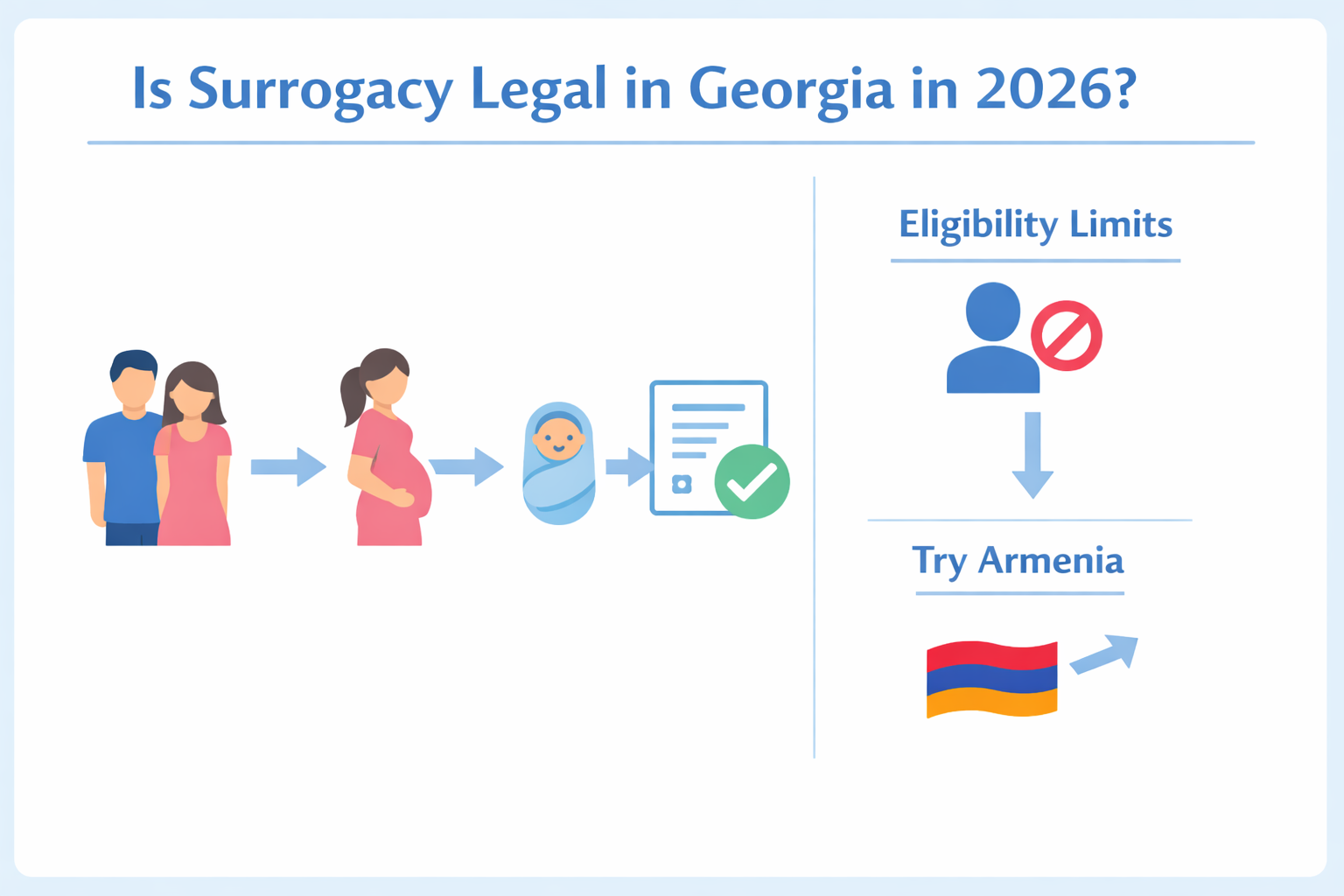
Georgian law allows surrogacy for heterosexual couples who are either officially married or can prove they have lived together for at least one year. A medical reason for using surrogacy is also required, usually in the form of a doctor’s note confirming that pregnancy is not possible or not recommended.
Single individuals and same sex couples are not eligible under current Georgian law .
This is where Armenia comes in as a practical alternative. In Armenia, surrogacy programs are available to single patients, including foreigners, which makes it a common second option for those who do not meet Georgian criteria.
How the Law Works in Practice
Georgia is one of the few countries where the legal side of surrogacy is relatively straightforward.
The surrogate mother has no parental rights over the child. Once the baby is born, the intended parents are immediately recognized as the legal parents and are listed on the birth certificate . There is no adoption process and no court involvement required after birth.
Another important rule is that the surrogate cannot also be the egg donor. However, donor eggs or sperm can still be used as part of the program.
Have There Been Any Recent Changes
In 2023, there were announcements about possible restrictions on surrogacy for foreign citizens. This created a lot of confusion online.
As of 2026, no changes have been implemented. Surrogacy remains fully legal for international couples, and clinics continue to operate under the same regulations as before. This is why Georgia still attracts patients who were previously considering Ukraine or other European destinations.
What Foreign Couples Need to Prepare
The legal process is document-heavy, but predictable once you know what is required.
Couples need to provide an original marriage certificate or proof of cohabitation, translated into English, notarized and apostilled. Medical documentation confirming the need for surrogacy is also required. Passports, powers of attorney, and clinic agreements are part of the standard package.
If embryos are created in another country, additional paperwork is needed. This includes certificates of embryo creation and freezing, as well as medical test results from the time the embryos were created .
Getting these details right early avoids delays later, especially when applying for the child’s documents after birth.
How the Surrogacy Process Works
The process follows a clear sequence.
It starts with IVF or the use of existing embryos. If embryos are created locally, the process usually takes about two weeks in Tbilisi, depending on timing, preparation and the involvement of preimplantation genetic testing (PGT-A).
After that, a surrogate mother is selected and medically screened. Matching typically takes up to three months, depending on preferences and availability .
Once the surrogate is ready, embryo transfer takes place. If pregnancy is confirmed, the program moves into standard pregnancy monitoring until delivery. After birth, the legal documents are issued with the intended parents listed from the start.
Costs of Surrogacy in Georgia
Cost is one of the main reasons couples consider Georgia.
Surrogacy programs typically range from about 41,000 USD to 75,000 USD depending on the structure and number of attempts included . Programs differ based on whether embryos are already available, whether donor eggs are used, and how many transfers are included.
IVF costs are separate if embryos are not yet created. A full IVF cycle usually ranges from around 6,000 to 9,500 USD depending on whether genetic testing is included .
Even when adding travel and accommodation, the total cost is still significantly lower than in the US or Western Europe.
Legal Status of the Child After Birth
One of the strongest points of the Georgian system is how parenthood is handled.
The intended parents are listed directly on the birth certificate. There is no need for adoption or court approval after delivery. This simplifies the process compared to many other countries.
However, some embassies require additional steps before issuing a passport for the child. In many cases, this includes a DNA test to confirm the biological link between the father and the baby .
Processing times vary by country. For example, UK cases tend to take longer due to additional checks.
What If You Do Not Qualify in Georgia
Some couples reach this point and realize they do not meet the legal criteria.
If you are single or cannot provide proof of a relationship, Georgia will not be an option. In those cases, the SILK Medical clinic in Yerevan, Armenia is often the next step. The legal framework there allows single individuals to proceed, while keeping a similar medical approach.
This kind of flexibility matters when you are comparing countries, since eligibility rules can be stricter than medical requirements.
Where SILK Medical Fits In
SILK Medical in Tbilisi works with international patients across IVF, surrogacy, and egg donation programs, including cases with shipped embryos and donor materials. The clinic also coordinates the legal side, including documentation, surrogate matching, and post-birth paperwork.
For patients who do not qualify under Georgian law, cases can be redirected to the Armenia branch, where local legislation allows a broader range of participants.
What This Means for You
Surrogacy in Georgia remains legal and accessible for foreign couples in 2026, with a clear legal structure and predictable process. The main limitations are around who qualifies, not whether the system works.
If you meet the criteria, Georgia, and SILK Medical in particular, offers one of the more straightforward setups available today. If not, nearby options like Armenia can still keep the process moving forward without starting from scratch.

 English