


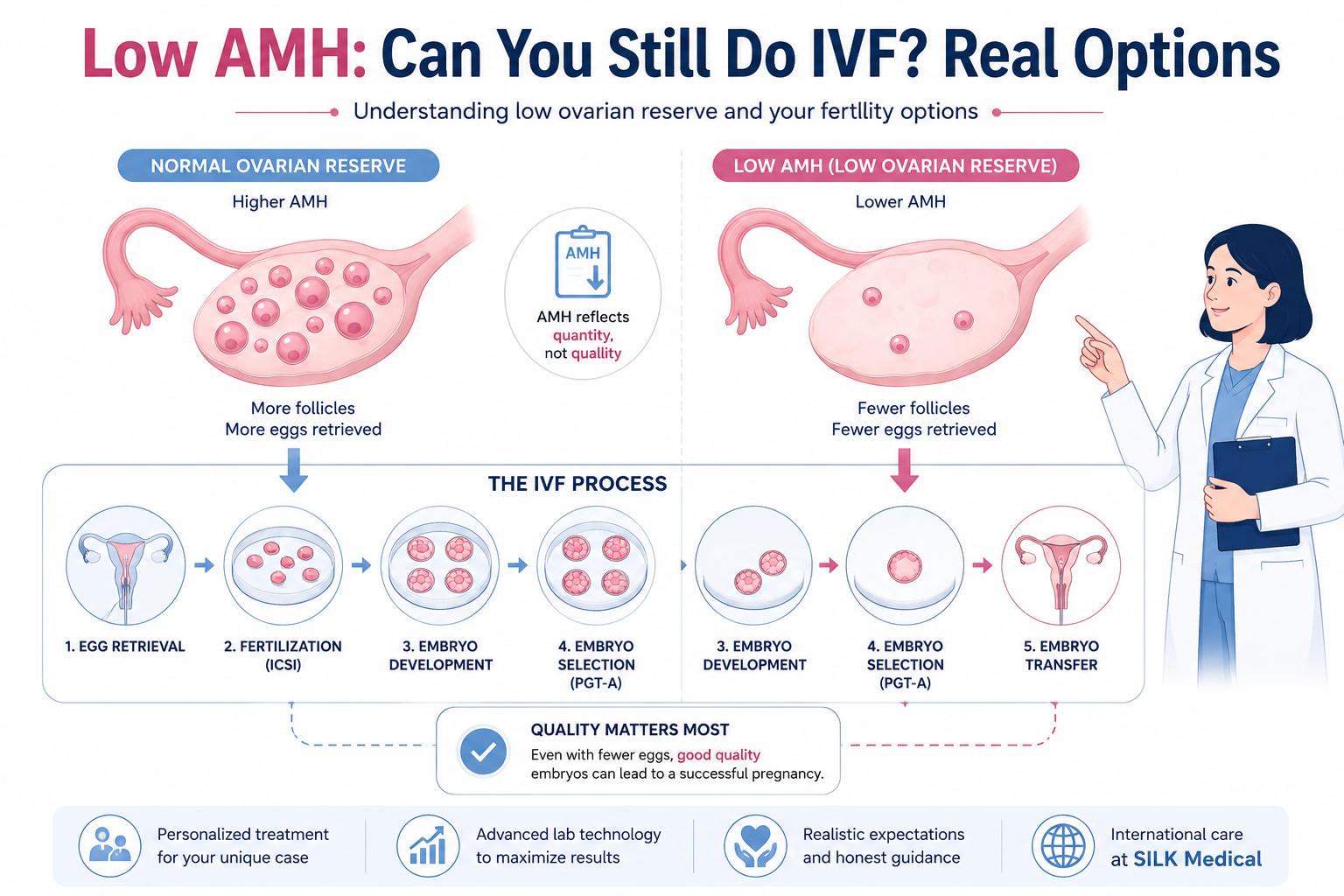
Low AMH is one of the most common reasons patients start questioning whether IVF is still worth trying. It usually comes up during routine testing, often before any treatment has even started, and it can quickly shift how a case is viewed.
This shows up in a large share of consultations with SILK Medical’s international patients, especially those who were previously told their chances are too low. AMH measures ovarian reserve, meaning the expected number of eggs that can be retrieved, but it does not directly reflect whether pregnancy is possible.
Can You Still Do IVF with Low AMH?
Yes, in many cases IVF is still possible. The main limitation is the number of eggs that can be retrieved in a cycle. With low AMH, the ovaries usually respond less to stimulation, which means fewer eggs, fewer embryos, and less room for selection. A PubMed study of women with very low AMH found that IVF can still lead to pregnancy, though age significantly affects the outcome.
For example, a patient with normal AMH might produce 10 to 15 eggs in one cycle. With low AMH, that number may drop to 2 to 5. That does not mean the cycle is unsuccessful. It simply means each egg carries more weight, and results often depend on quality rather than quantity.
Age plays a big role here. A younger patient with low AMH can still produce viable embryos and achieve pregnancy. The same AMH level at 40 leads to a very different expectation because egg quality declines over time.
What Changes in IVF When AMH Is Low
The overall structure of IVF stays the same, but the strategy shifts.
Stimulation protocols are usually adjusted to get the best possible response from the ovaries. Medication doses may be higher, and timing becomes more precise. Even with that, the number of retrieved eggs is often limited, so each step in the lab becomes more important.
Embryo development is closely monitored, and genetic testing such as PGT A is often used to identify embryos with normal chromosomal structure. This helps avoid transfers that are unlikely to implant or may lead to miscarriage.
Because fewer embryos are available, some patients go through more than one cycle to build a small number of embryos before moving to transfer.
When IVF with Your Own Eggs Still Makes Sense
There are clear situations where continuing with your own eggs is a reasonable plan.
Younger patients, especially under 35 to 37, often still have good egg quality even when AMH is low. In these cases, even one or two embryos can be enough.
Patients who are early in the process and have not yet tried IVF are also good candidates to attempt at least one cycle. The actual response to stimulation often provides more useful information than AMH alone.
Some patients also prefer to try with their own biological material first, even if the expected number of embryos is low. This is a valid approach when expectations are realistic and the timeline allows for it.
When It Makes Sense to Consider Other Options
There are also situations where continuing with standard IVF becomes less efficient.
If AMH is very low and age is closer to 38 to 40 or above, the chance of obtaining chromosomally normal embryos drops significantly. Multiple IVF cycles may still result in no usable embryos.
Repeated failed cycles are another signal. If stimulation produces very few eggs each time and no embryos reach the transfer stage, it may be time to change strategy.
At that point, options like donor eggs become more predictable, since they rely on younger egg quality. For some patients, creating embryos first and planning for surrogacy later is also part of the discussion, especially when there are additional medical factors.
Cost Reality: How Location Changes the Plan
Cost often shapes how many attempts a patient can realistically make.
In the United States, one IVF cycle typically ranges from 15,000 to 25,000 USD, often without medications and genetic testing included. In many European countries, the range is slightly lower but still significant.
A full IVF cycle with genetic testing for up to five embryos at SILK Medical is around 6,500 to 7,000 USD, with medications included in the program. This difference allows patients to consider more than one cycle if needed, which is often important in low AMH cases where results may vary from cycle to cycle.
Why Approach Matters More Than a Single Number
SILK Medical reproductive specialists always emphasize that AMH is one data point. It helps estimate ovarian reserve, but it does not define the outcome on its own.
Two patients with the same AMH can have very different results depending on age, ovarian response, sperm quality, and how embryos develop in the lab. Treatment planning in these cases usually focuses on maximizing each cycle and adjusting quickly based on real response rather than relying only on initial test results.
Low AMH changes the strategy, but it does not automatically remove IVF as an option.

 English