



If you are getting ready for in vitro fertilization (IVF), your doctor might recommend either the conventional way of fertilizing eggs or intracytoplasmic sperm injection (ICSI). Both happen in the embryology lab, but the fertilization process is different for each.
This article explains how conventional IVF and IVF with ICSI are different, when each method is used, and how doctors decide which option is best for each couple.
What is conventional IVF?
With conventional IVF, eggs and prepared sperm are placed together in a special lab setting. The sperm moves through the egg’s outer layers by itself and fertilizes the egg.
Embryologists watch how the fertilized eggs grow. Embryos that are ready can be transferred into the uterus or frozen for later use.
Doctors use this method when test results show that eggs and sperm can join successfully without extra help.
What is ICSI, and how is it performed within an IVF cycle?
ICSI stands for intracytoplasmic sperm injection. In this method, an embryologist uses a fine microneedle to inject a single chosen sperm directly into a mature egg.
Unlike conventional IVF, the sperm does not have to get through the egg’s outer layers by itself. The embryologist takes care of that step.
The procedure takes place in several stages:
- The embryologist evaluates the retrieved eggs and selects those that are mature and suitable for ICSI.
- Under a microscope, the embryologist chooses a sperm to be injected.
- The embryologist uses a microinstrument to place the sperm into the egg.
- The embryologist then monitors fertilization and further embryo development.
ICSI does not replace the entire IVF program. It is simply another way to fertilize eggs as part of the process.
When might ICSI be recommended?
Doctors usually consider ICSI when some factors make it harder for fertilization to happen in the normal way.
1. Significant sperm abnormalities
If sperm count or movement is much lower than normal, or if there are other male fertility issues, ICSI can help overcome problems during fertilization.
Doctors do not make this decision based on just one part of a semen analysis. They look at the whole clinical situation.
2. Surgically retrieved sperm
Sometimes, sperm is collected directly from the testicular tissue or epididymis with a medical procedure. When this happens, ICSI may be suggested to deliver the sperm into the egg.
3. Fertilization problems in a previous cycle
If a previous conventional IVF cycle led to fewer fertilized eggs than expected, or if fertilization did not happen, the reproductive specialist and embryologist may choose a different fertilization method for the next cycle.
4. Other individual clinical circumstances
Sometimes, doctors may talk about ICSI based on past treatments, how many eggs are available, and other factors. But having fewer eggs, being older, or having unexplained infertility does not always mean ICSI is better than conventional IVF.
The final decision is always made on an individual basis.
How does conventional IVF differ from IVF with ICSI?
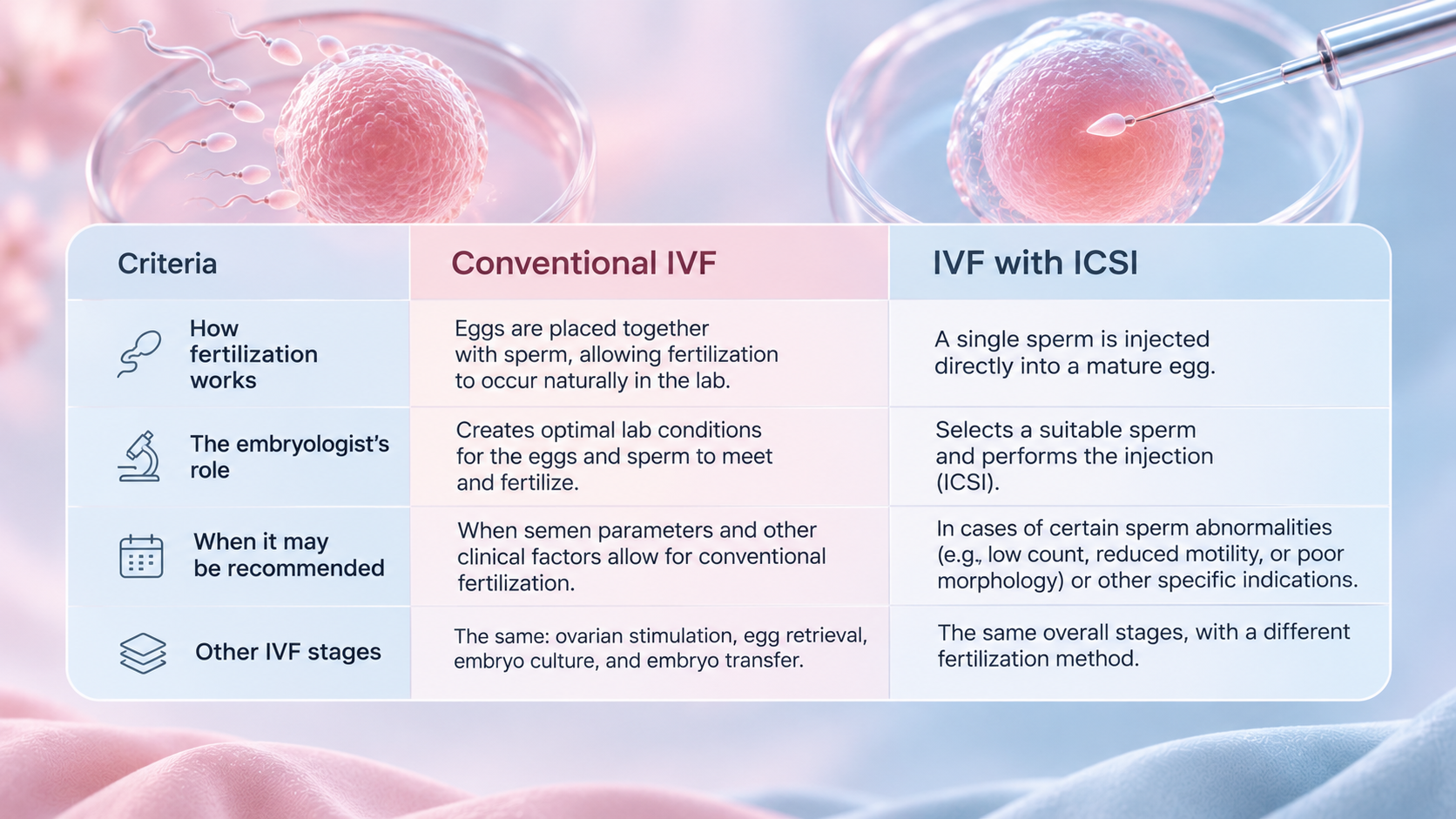
The main difference is in how fertilization happens. The rest of the process is mostly the same, but the exact steps depend on each couple’s needs.
| Criteria | Conventional IVF | IVF with ICSI |
| How fertilization works | Eggs are placed together with sperm | A single sperm is injected directly into a mature egg |
| The embryologist’s role | Creates the conditions for eggs and sperm to interact naturally in the lab | Selects a sperm and performs the injection |
| When it may be used | When semen parameters and other clinical factors allow for the conventional method | In cases of certain sperm abnormalities or other specific indications |
| Other IVF stages | Ovarian stimulation, egg retrieval, embryo culture, and embryo transfer | The same overall stages, with a different fertilization method |
Is ICSI always more effective than conventional IVF?
ICSI lets doctors inject a chosen sperm directly into the egg, but this does not guarantee fertilization, embryo growth, implantation, or pregnancy. The American Society for Reproductive Medicine (ASRM) does not recommend using ICSI routinely if there is no male infertility factor.
It is useful to separate the treatment into several stages:
- Fertilization: the sperm enters the egg and embryo development starts.
- Embryo development: the changes that happen after fertilization.
- Implantation: the embryo attaches to the endometrium, which is the inner lining of the uterus.
- Pregnancy and what happens next: these later stages also depend on many factors.
ICSI mainly helps with the fertilization stage. It does not solve every cause of infertility, does not guarantee normal embryo growth, and does not prevent failed implantation.
If there are no major sperm problems or other clear reasons for ICSI, this method does not always work better than conventional IVF. So, ICSI should not be picked just in hopes of a higher success rate.
Which method is right for your couple?
Choosing how to fertilize the eggs is part of a treatment plan made just for you. The reproductive specialist looks at both partners’ test results, and the embryologist considers the details of the reproductive cells and any past lab cycles.
Before you start treatment, it helps to talk with your doctor about a few questions:
- Are there any indications for ICSI in your particular situation?
- Which specific features of the semen analysis and other tests affect the choice of method?
- Were there any fertilization difficulties in previous cycles?
- What are the expected benefits and limitations of each option for your couple specifically?
It is not always possible to know the outcome ahead of time, but by carefully looking at your situation, the team can choose the best approach and avoid unnecessary procedures.
At Silk Medical, IVF programs are designed for each patient’s unique needs. The reproductive specialists and embryologists work as a team, and all lab work is done in a dedicated embryology lab.
If you are planning IVF and are unsure which fertilization method is best for you, schedule a consultation with the specialists at Silk Medical. Your doctor will explain your test results, talk through your treatment options, and help you plan your next steps.

 English