


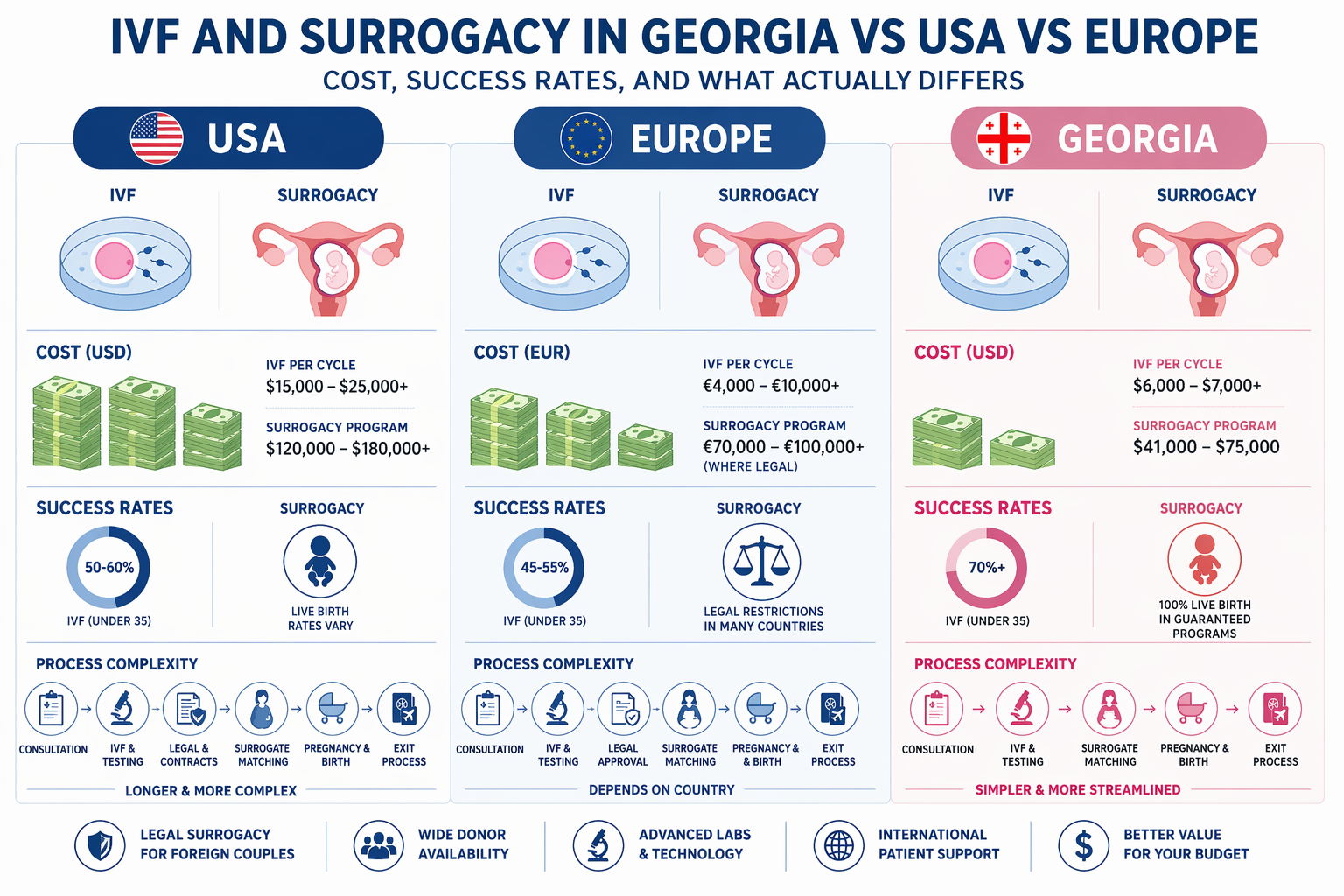
For many intended parents, the first real comparison starts with three regions. The United States, Europe, and Georgia. The differences look obvious at a glance, especially when it comes to price, but the real gap goes much deeper.
Treatment structure, legal access to surrogacy, donor availability, and how clinics coordinate the entire process all shape the final outcome. A large share of international patients at SILK Medical in Tbilisi arrive after reviewing options in the U.S. and several European countries, trying to understand why the same IVF or surrogacy plan can vary so widely depending on where it is done.
The systems are built differently
The United States has a large number of clinics, strong reporting standards, and broad access to advanced procedures. It also has a fragmented cost structure, where each step is often billed separately. Europe is not a single system at all. Each country has its own rules on IVF, donor programs, and surrogacy, which means patients often compare Spain, Greece, the Czech Republic, or the UK as completely separate options. The legal situation there varies widely across member states, with many countries banning surrogacy or allowing only limited forms of it.
Georgia is easier to explain in comparison. The model is more centralized. IVF, donor programs, and surrogacy can be handled within one coordinated structure, which reduces the need to split the process across different providers or countries. For eligible couples, the legal framework also removes some of the uncertainty that exists in parts of Europe, where surrogacy may be restricted or handled through courts.
IVF costs. Where the numbers start to diverge
IVF pricing is usually the first trigger for comparison. In the United States, a single IVF cycle typically ranges from 15,000 to 25,000 USD. When medications, genetic testing, and additional procedures are added, the total often reaches 20,000 to 35,000 USD per attempt.
European clinics often offer lower base prices, but costs still vary widely depending on the country, clinic, and whether donor material or genetic testing is involved. Medications are also often priced separately.
A full IVF cycle with one embryo transfer at SILK Medical starts from 6,000 USD, and around 7,000 USD when PGT-A testing for up to five embryos is included. Donor egg programs typically range from 6,500 to 9,500 USD plus donor compensation, depending on the number of embryos tested and transfers included.
In practice, many patients comparing options notice that the total price in the U.S. grows as additional steps are added during treatment, while European clinics vary depending on how much is included upfront.
Surrogacy costs. Where the gap becomes clear
Surrogacy is where the regional differences become much more pronounced. In the United States, full surrogacy programs usually range from 150,000 to 250,000 USD, and can go higher depending on agency fees, insurance, and surrogate compensation. This places them out of reach for many international patients. In Europe, commercial surrogacy is either restricted or not available in many countries, which leads patients to look outside the region.
Georgia remains one of the few jurisdictions where surrogacy is both legal and structured in a way that is accessible to foreign couples.
Programs using own embryos at SILK Medical typically start around 41,000 to 43,000 USD, depending on the number of transfers included. Programs with donor eggs are structured around 51,000 USD for up to three transfers, while the guaranteed program reaches 75,000 USD and includes repeated attempts until a live birth.
Success rates. Why direct comparison is tricky
Success rates are often presented as simple percentages, but they depend on several variables. Age of the patient, use of donor eggs, embryo quality, and whether genetic testing is used all affect outcomes. Reporting standards also differ between regions.
In the United States, national reporting systems provide large datasets, but they still require careful interpretation. European data is often country-specific and less uniform.
Internal data at SILK Medical shows around 60-70 percent success rates on the first attempt for women under 35, and higher outcomes in programs that include donor eggs and genetic testing. Guaranteed surrogacy programs are structured to continue attempts until a live birth is achieved within the program conditions.
What matters more than a single number is how the program is built around those variables.
What actually differs beyond price
Laboratory setup and embryo handling can differ between clinics. Technologies such as time-lapse embryo monitoring and sample tracking systems reduce variability in the process. SILK Medical uses systems like EmbryoScope and IVFID Witness, which are part of its standard workflow rather than optional add-ons.
Donor availability also varies. In some European countries, donor pools are limited or regulated in ways that extend timelines. In Georgia, access to donors from a wider regional pool allows more flexibility in matching.
Coordination is another difference that becomes visible only during treatment. In the U.S. or across parts of Europe, patients may work with separate clinics, agencies, and legal advisors. In Georgia, the process is often handled within one structure, which reduces handoffs between providers.
Legal structure. Where decisions are often made
Legal clarity plays a larger role in surrogacy than in IVF alone. In many European countries, surrogacy is restricted, prohibited, or requires court involvement after birth. This creates uncertainty around parental rights and timelines for leaving the country with the child.
In Georgia, surrogacy is legally permitted for married couples or couples with documented cohabitation, and the intended parents are recognized within the legal framework from the start of the process.
For patients who do not meet these criteria, Armenia becomes relevant as an alternative. The legal structure there allows single intended parents to proceed under specific conditions, using non-local surrogates and their own biological material.
Timeline and logistics. How the process unfolds
Timelines depend on the type of program. IVF alone can be completed within a few weeks when preparation is done in advance. Surrogacy adds additional stages, including donor selection, embryo creation, surrogate matching, and pregnancy management.
In Georgia, surrogate matching typically takes up to three months, depending on specific requirements. IVF cycles require about two weeks on-site for the female partner, while embryo development and genetic testing continue after that.
Who tends to choose each option
Patients who prioritize staying within their own country and have the budget for it often remain in the United States. Those focusing only on IVF sometimes look to specific European clinics, depending on regulations and donor access.
Patients who need both IVF and surrogacy, or who want a clearer structure with predictable costs, tend to include Georgia in their shortlist. This is especially true for international patients comparing total program cost rather than individual procedures.
Why Georgia keeps coming up in these comparisons
For many international patients, the comparison shifts once they look beyond individual procedures and start calculating the full process. IVF, donor work, surrogacy, legal steps, and timelines all stack together.
That’s usually where Georgia enters the shortlist. The structure is simpler to understand, the total cost is easier to predict, and the entire process can be handled within one system instead of spread across multiple providers or countries.
For many patients reviewing options across the United States and Europe, it is this combination that brings Georgia into the conversation, and keeps it there once the details are fully understood.

 English