



When a first IVF attempt doesn’t end in pregnancy, many patients start to question their odds. The doubts pile up fast: is another cycle worth it, does it make sense to keep going, and does one disappointment mean IVF simply isn’t meant for you?
In truth, a first cycle that doesn’t lead to pregnancy is far from rare. The result can sting – yet a single attempt tells you remarkably little about what lies ahead.
What a First IVF Attempt Actually Reveals
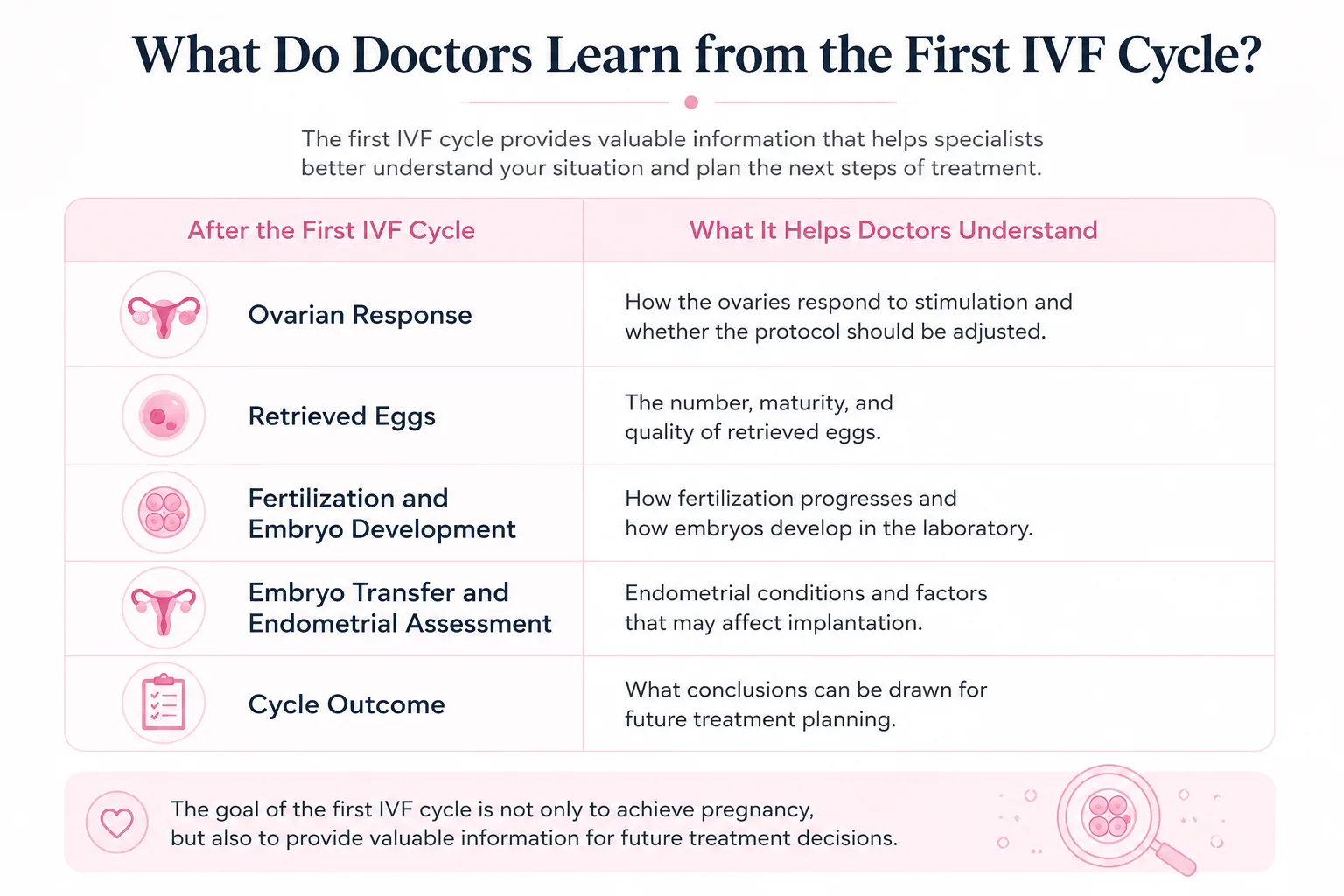
A first cycle hands clinicians far more to work with than most people imagine. Even when pregnancy doesn’t follow, the program leaves behind a trail of information that sharpens the picture of a particular case and points toward the next move.
The cycle shows how the body answers treatment, how the embryos take shape, and whether any quiet factors might be tipping the scales against conception. Armed with that, doctors can make decisions grounded in evidence rather than guesswork.
Sometimes the first round simply confirms that the chosen course was sound and worth repeating. Other times it calls for further testing or a recalibrated strategy to lift the odds next time around.
If a Good Embryo Was Transferred, Why No Pregnancy?
It’s worth understanding that even a top-grade embryo carries no guarantee. Successful implantation – and a pregnancy that holds – depends on a constellation of factors falling into place at once: the state of the endometrium, the embryo’s genetic makeup, and the subtle mechanics of implantation itself.
On top of that, not every variable can be read in advance. That is exactly why, even at the world’s most accomplished fertility centers, pregnancy may not follow the first transfer of a healthy embryo.
One Attempt Doesn’t Settle the Question
A negative result after a single cycle rarely offers an honest measure of future chances. For that reason, specialists urge patients to view treatment through a wider lens, rather than passing judgment on a lone attempt.
Science leans the same way. In a large study published in the journal Human Reproduction, researchers combed through the outcomes of nearly 179,000 women who underwent IVF. Their finding: the likelihood of taking home a baby keeps climbing across successive cycles and is by no means capped by the first try. After three full cycles, the chance of a live birth rose to 42.3%.
None of this means every couple will need several rounds. But a single failed attempt, on its own, says nothing about pregnancy being out of reach.
Should Anything Change Before the Next Try?
In some cases, physicians may suggest repeating the cycle largely unchanged – when the earlier protocol performed well and nothing obvious is begging for adjustment.
Yet every story is its own. If the first cycle hints at why things fell short, or where the prognosis might be brightened, the strategy can be rethought.
Depending on the clinical picture, the options on the table may include:
- genetic testing of embryos (PGT-A).
- a change to the stimulation protocol.
- banking embryos across several cycles.
- further evaluation of the endometrium.
- the use of donor eggs.
This is why, after a setback, the question isn’t only whether to try IVF again – it’s whether there’s solid reason to change tack, a conversation best had with your physician. At SILK Medical, each subsequent program is built from the ground up around the patient’s medical history and the lessons of earlier cycles.
What Genuinely Moves the Needle in IVF?
A woman’s age remains among the weightiest factors – though hardly the only one.
The odds of pregnancy also hinge on embryo quality, the partner’s sperm, the condition of the endometrium, the roots of the infertility, and what the embryology lab is capable of.
Modern tools let specialists read embryo development with greater precision and choose, with more confidence, which embryo to transfer.
For patients facing a diminished ovarian reserve, a history of failed attempts, or stubborn forms of infertility, the laboratory’s capabilities carry particular weight. SILK Medical draws on advanced embryo culture techniques, genetic testing (PGT-A), and EmbryoScope® technology, which lets embryologists watch development unfold in time-lapse without ever lifting the embryos from the incubator. The payoff is a clearer view of how embryos progress under steady, undisturbed conditions – and richer ground for clinical decisions.
What Matters Most to Remember
A failed first attempt is not a verdict on your future chances of pregnancy.
For some, pregnancy arrives on the first try; for others, the road to parenthood simply runs longer. Either way, an empty result after one cycle doesn’t brand the treatment a failure.
SILK Medical cares for patients across a wide span of ages, including those with a diminished ovarian reserve, repeated IVF setbacks, and complex infertility. For many couples, it is precisely a recalibrated strategy, modern embryological technology, and a tailored approach that bring the long-awaited pregnancy within reach.
After a first disappointment, the wisest move is to resist hasty conclusions. One cycle without pregnancy doesn’t decide the outcome of the whole journey – and the path ahead always bends to the particular circumstances of each couple.

 English