



For many, the first pregnancy seemed simple. So when a second pregnancy takes longer, or does not happen at all, it can feel confusing and even a little frightening. If this is happening to you, know that you are not alone.
There are many reasons this can happen. Sometimes it is age. Sometimes it is a new health issue. Sometimes it is a change that appeared after your first child was born.
The only way to know for sure what is affecting your fertility now is to look carefully at your health and your partner’s health.
In this article, we will talk about what secondary infertility means, what can cause it, when to see a specialist, and why finding the reason is the first step toward the right treatment.
What Is Secondary Infertility?
According to The International Glossary on Infertility and Fertility Care (2025), developed in collaboration with the American Society for Reproductive Medicine (ASRM) and the International Committee for Monitoring Assisted Reproductive Technologies (ICMART), secondary infertility is defined as the failure to achieve pregnancy after one or more previous pregnancies despite regular unprotected sexual intercourse.
Being pregnant once does not mean your body, or your partner’s, has stayed the same. New factors can appear over time. That is why secondary infertility is its own condition and needs a careful look at both partners.
Why might it be difficult to conceive after the first pregnancy?
Age
is still one of the biggest factors. As women get older, both the number and quality of eggs go down. Men can also see changes in sperm quality as time passes.
But age alone is rarely the whole story. Doctors always look at the full picture, not just your age.
Changes in Health
Sometimes, new health issues appear after your first child. These are problems that were not there before.
In women, these may include:
- endometriosis;
- polycystic ovary syndrome (PCOS);
- thyroid disorders;
- ovulation disorders;
- changes in the uterine cavity;
- decreased ovarian reserve.
For men, fertility can be affected by chronic illnesses, infections, hormone changes, enlarged veins in the scrotum (called varicocele), past surgeries, and other factors.
Previous Pregnancy and Childbirth
Sometimes, changes from pregnancy or childbirth can play a role. Inflammation, surgery, or changes in the uterus or fallopian tubes can all make it harder to get pregnant again.
This doesn’t mean a natural pregnancy is off the table. Many of these changes can be found and treated, especially if you see a specialist early.
Why Do Both Partners Undergo Testing?
Many people assume that if the first pregnancy happened easily, any new problem must be on the woman’s side.
Changes could have occurred in either partner over time. That is why current international guidelines recommend evaluating both the man and the woman at the same time. This approach helps identify potential causes of reduced fertility more quickly and select the most effective treatment strategy.
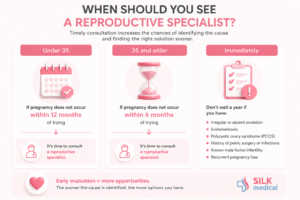
When Should You See a Reproductive Specialist?
According to the recommendations of the American Society for Reproductive Medicine (ASRM), women under 35 are advised to see a specialist if pregnancy does not occur within 12 months of regular unprotected intercourse.
For women 35 and older, it is best not to wait more than 6 months before seeing a specialist.
An evaluation may be needed sooner if any of the following are present:
- menstrual cycle irregularities;
- reproductive system disorders;
- a history of pelvic surgery;
- complications following a previous pregnancy or childbirth;
- abnormal semen analysis results.
Secondary infertility is not a single disease. It is a sign that something else is getting in the way of pregnancy.
Modern diagnostics do not just confirm the diagnosis. They also look for the factors that are preventing pregnancy. The doctor checks ovarian reserve, ovulation, the condition of the uterus and fallopian tubes, and possible male factors.
In many cases, once the cause is found, treating the underlying condition or correcting the problem is enough. If this is not enough, a specialist may recommend assisted reproductive technologies. During an IVF program, the embryo goes through several important stages of development, and its condition is checked every day by embryologists. You can read more about this in our article “Five Days in the Life of an Embryo: What Happens After Fertilization?”.
The main goal is always to find out why pregnancy is not happening, then choose the treatment that fits your situation best.
It is Important to Remember
If pregnancy does not happen after your first child, do not jump to conclusions or wait too long to see a specialist. The causes of secondary infertility can be different for everyone, but in many cases they can be found and successfully treated.
At SILK Medical, we start by looking at the health of both partners. We review your reproductive history, test results, age, and any unique health factors to identify what is affecting fertility and build a treatment plan just for you.
This approach helps us find the reason for conception difficulties and choose the treatment that’s most likely to work for you.
The sooner you start the diagnostics, the better your chances of finding a solution and moving closer to the pregnancy you hope for.

 English