



Ten years ago, most people saw egg freezing as a way to protect fertility before cancer treatment or other health issues that might affect having children.
Now, things are different. Many women choose to freeze their eggs, not because they have fertility problems, but to keep their options open for starting a family later.
Each woman has her own reasons. Some haven’t found the right partner, some are focused on work or school, others want to be financially stable first, or just aren’t ready for pregnancy yet.
Thanks to modern medicine, women can freeze their eggs while they are at their best quality. Still, egg freezing does not promise a future pregnancy. It simply gives you a better chance to use your own eggs when you decide to have a child.
In this article, we’ll talk about who might benefit from egg freezing, the best time to consider it, what you should know before deciding, and how to choose a clinic.
Why Is Egg Freezing Becoming More Popular?
A few years ago, most women chose this procedure for medical reasons. Now, more women are making this choice on their own terms.
In Europe and North America, more people are including fertility preservation in their family planning. Research from the American Society for Reproductive Medicine (ASRM) and other groups shows that elective egg freezing is becoming more common each year, and women are choosing the procedure at younger ages because fertility changes over time.
It’s not just about careers. People also choose egg freezing because they don’t have a partner, want to achieve personal or work goals first, have medical reasons, or want to avoid feeling rushed when planning a pregnancy.
What does egg freezing mean?
Egg freezing is a way to preserve a woman’s eggs by freezing them very quickly, a process called vitrification.
Later, the eggs can be thawed and used in IVF to try for a pregnancy and subsequent development of an embryo.
Vitrification helps protect the eggs from damage during freezing and thawing. That’s why it’s now the standard method for fertility preservation worldwide.
When should you consider fertility preservation?
Deciding to freeze your eggs depends on your age, health, and life plans. In some cases, it’s especially helpful to talk with a reproductive specialist.
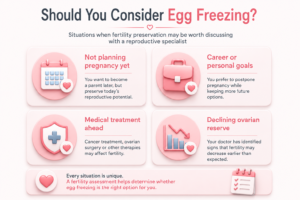
It’s worth considering the possibility of fertility preservation if:
- you are not planning pregnancy right now, but want to preserve more options in the future
- you are over 30 years old, and you assume that you will have a child later
- a doctor has informed you of the decline in your ovarian reserve
- you are scheduled to undergo a treatment that can affect fertility
- you have a family history of early menopause
- you want to assess the state of your reproductive function in advance
Even if egg freezing won’t be required in the end, consultation and evaluation will help you to assess the ovarian reserve objectively and make an informed decision based on facts rather than assumptions.
When is the best time to have this procedure?
A common question women ask their reproductive specialist is, “Is it too late for me to freeze my eggs?”
Age is important, but it’s not the only thing to think about when making this decision.
Most experts agree that doing the procedure earlier gives you a better chance of getting more healthy, mature eggs.
This doesn’t mean egg freezing isn’t an option after 35. Your doctor will look at your AMH levels, number of follicles, overall health, and other factors to decide what’s best for you.
That’s why the process starts with a meeting with a reproductive specialist and a full fertility check-up.
What’s important to know before making a decision?
Egg freezing gives you more options, but it’s important to know what it can and can’t do.
It’s not a guarantee of pregnancy
Even with the best technology, there’s no guarantee of having a child in the future. Your age when you freeze your eggs, how many you freeze, their quality, and other factors all play a role.
Sometimes one cycle is not enough
The number of eggs collected is different for everyone. Sometimes, your doctor might suggest more than one cycle to improve your chances of success later.
Eggs can be stored for many years
If eggs are stored correctly, they keep their quality and can be used whenever you decide to try for a baby.
Why are more and more women considering Georgia for fertility preservation?
Recently, Georgia has become a popular place for fertility preservation. Many patients choose it because of several benefits:
- state-of-the-art embryology laboratories
- no long wait times to begin treatment
- affordable costs compared to many countries in Europe and North America
- convenient international flight connections
- the ability to complete the program in a relatively short period of time
For patients from other countries, getting support in English and Russian and staying in touch with their doctor after going home is also very important.
Fertility Preservation Program at Silk Medical
At Silk Medical, you start with a meeting with a reproductive specialist and a check of your ovarian reserve. After that, the doctor creates a treatment plan just for you and chooses the best stimulation method.
The eggs are frozen using vitrification in a modern lab. If you need them later, they can be used in IVF.
If you’re from another country, Silk Medical supports you at every step, from your first online meeting to egg storage and planning for pregnancy later.
The Most Important Thing to Remember
Egg freezing doesn’t let you put off motherhood forever, and it’s not a sure way to have a child. It’s a chance to save your fertility while your eggs are at their best, giving you more choices for family planning.
If you are thinking of becoming a mother in a few years or if you want to better understand your reproductive potential, you don’t have to decide on the procedure right away. The first step is to consult a reproductive specialist and assess your ovarian reserve. Sometimes this information helps you make a calm, informed decision based not on fear but on objective medical data.

 English