


Should you check hormones, ovarian reserve, tubal patency, and the male factor? If you have already done some of these tests, will you need to repeat them?
Before starting IVF, it is useful to know which tests are truly needed to prepare for the program and which are only ordered in certain cases.
In this article, we will cover the main tests and exams for women and men, explain how to handle results from earlier work-ups, and describe any extra studies that might be needed.
Where to start
If you have already decided to move ahead with IVF, the first step is a consultation with a reproductive endocrinologist.
The visit typically covers previous pregnancies and IVF attempts, past illnesses and surgeries, cycle characteristics, and prior ultrasound and lab results. If a male partner is part of the program, his work-up begins at this stage as well. ASRM recommends evaluating both partners at the same time, including the male reproductive history and a semen analysis.
After the consultation, the doctor will decide which tests you need to complete before starting the program. If you have already done some tests or exams, you can share those results with your doctor. You do not always need to repeat everything.
At Silk Medical, patients can start preparing before coming to Georgia. You can send your previous exam results and medical records to the reproductive endocrinologist for review. The doctor will then decide which information can be used and which tests need to be repeated or added.
What tests do women need before IVF?
Pelvic ultrasound
One of the first investigations before IVF is a transvaginal pelvic ultrasound.
During the scan the doctor assesses the uterus and ovaries and looks for fibroids, polyps, endometriomas and other findings that may matter for treatment planning.
Ultrasound is usually the first step in planning the program because it shows the current condition of the reproductive system.
At Silk Medical, a gynecological exam and the necessary ultrasound studies are available as part of preparation for treatment.
Ovarian reserve
Ovarian reserve reflects primarily the number of eggs remaining in the ovaries. It is not the same as egg quality or the ability to conceive.
It can be assessed using:
- AMH (anti-Müllerian hormone);
- antral follicle count (AFC) on ultrasound;
- FSH and estradiol in selected situations.
However, AMH should not be seen as the only fertility test. Even if ovarian reserve is low, it does not always mean a woman cannot get pregnant. The result is considered along with age, ultrasound, medical history, and other information.
If you are interested in preserving fertility, see also our article «Can you delay motherhood? What to know about egg freezing».
Hormonal tests
Beyond ovarian reserve, the doctor may order additional hormonal tests depending on the situation.
For example, estradiol, LH, TSH or prolactin may be checked when there is a medical reason, a cycle irregularity or other factors that need clarification before treatment.
You do not need to order a full set of hormone tests by yourself before the consultation. Not every patient needs every hormone test, so it is best to decide on the list together with your reproductive endocrinologist.
Baseline tests before IVF
Before the program starts, both reproductive health and overall health are assessed. Depending on the program, medical history and clinic requirements, the following may be required:
- HIV, syphilis, hepatitis B and C;
- complete blood count;
- urinalysis;
- blood biochemistry;
- coagulation profile;
- PCR testing for selected infections;
- vaginal flora smear;
- cervical cytology.
Blood group and Rh factor, an ECG and a physician’s clearance may also be required.
Some of these tests are only valid for a certain period. Results from several months ago may not be accepted for your current program. Your doctor or clinic coordinator will tell you which tests need to be updated.
For patients traveling abroad for IVF, this is especially helpful. Some of the work-up can be done before your trip, and you can send the results to the clinic ahead of time.
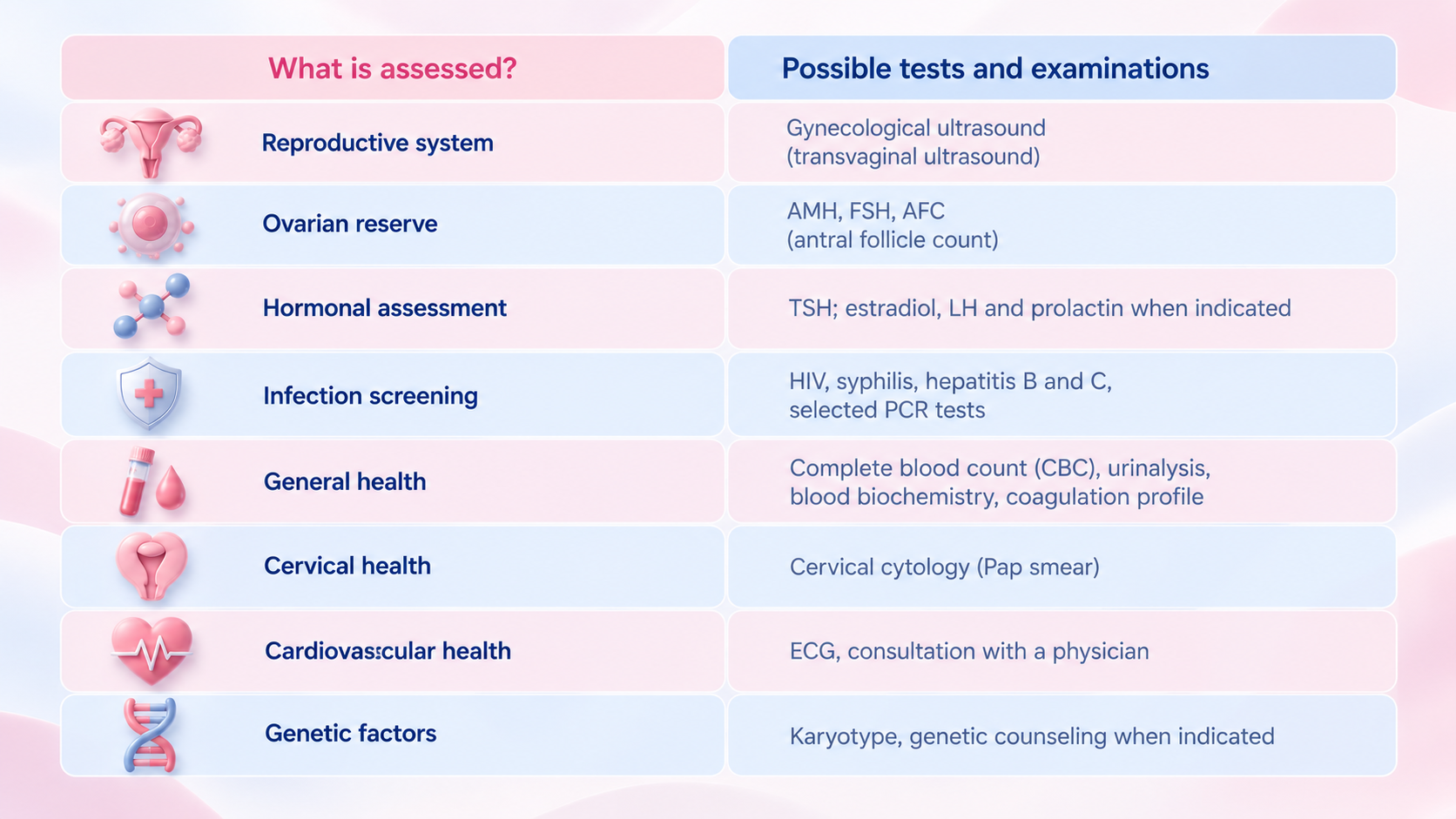
Important: the exact list and validity period of tests depend on the program, the patient’s medical history and clinic requirements.
What tests do men need before IVF?
The male work-up starts with a semen analysis. It evaluates:
- sperm concentration;
- total sperm count;
- motility;
- morphology;
- ejaculate volume.
What else may be needed?
Hormone tests, such as FSH and testosterone, may be needed if there is a major problem with sperm production,

 English