



For some prospective parents, pregnancy is not possible or could be dangerous for their health. In these cases, gestational surrogacy is an option. This program involves creating an embryo through IVF and transferring it to a surrogate mother, who carries the child to term.
Surrogacy can help people become parents when carrying a child themselves is not possible. However, it is not right for everyone and always needs a personal medical evaluation.
This article looks at the main situations when doctors might suggest surrogacy, what factors are considered before starting, and what future parents should know ahead of time.
6 Situations in Which Surrogacy May Be Considered
1. Absence of a Uterus
One clear medical reason for surrogacy is when a woman does not have a uterus.
This can happen because of a condition present from birth or if the uterus was removed by surgery. In these cases, the ovaries may still work, so a woman can use her own eggs to create embryos through IVF.
If her own eggs cannot be used, donor eggs can be used instead for the program.
2. There Are Significant Changes to the Uterus
Sometimes the uterus is present, but its condition makes pregnancy unsafe.
This can include major changes in the shape of the uterus, serious damage to the uterine cavity, or other problems that make a successful pregnancy much less likely.
In these cases, doctors look at both whether pregnancy is possible and how safe it would be. After an examination, the doctor will discuss possible treatments and may suggest surrogacy if needed.
3. Pregnancy May Pose a Risk to a Woman’s Health
Sometimes a woman can get pregnant, but being pregnant could seriously risk her health.
For example, this can happen if she has serious heart, kidney, or lung disease, or other conditions where pregnancy puts extra strain on her body or could make her illness worse.
In these situations, the doctor looks at the diagnosis, how serious it is, possible complications, and risks for both the woman and the baby. If carrying the pregnancy is not safe, surrogacy may be suggested as an option.
4. There Have Been Repeated Unsuccessful IVF Attempts
Sometimes, after several failed IVF attempts, doctors look for reasons why pregnancy is not happening. If good-quality embryos have been transferred more than once but pregnancy still does not occur, a specialist may check the lining of the uterus, how embryos implant, and other possible reasons.
If no clear reason for the failed attempts is found, the doctor may talk with patients about other options, such as a surrogacy program.
However, just having several failed attempts at IVF does not mean surrogacy is needed. It is important to find out why the attempts failed and see if changing the approach could help.
5. Carrying a Pregnancy to Term on One’s Own Is Biologically Impossible
Surrogacy may also be considered when the intended parents cannot carry a child to term themselves.
For example, this applies to single men and male couples who want to become parents using assisted reproductive technologies. In these cases, donor eggs and the sperm of the intended father or one partner are used to create an embryo, which is then carried to term by a surrogate mother.
Whether this kind of program is possible depends on both the medical situation and the laws in the country where treatment happens. It is important to check the medical, legal, and organizational rules before starting.
6. A Previous Pregnancy Was Associated with Severe Complications
Sometimes surrogacy is considered after a previous pregnancy with serious complications. If this happened before, the doctor will look at how likely it is to happen again and what risks it could pose to the woman’s health.
It is especially important to think about cases where a past pregnancy seriously affected the woman’s health or where problems could be dangerous in a future pregnancy.
Based on the examination results, the doctor may suggest other options, including surrogacy.
The situations above do not mean surrogacy is always needed. Each case needs to be looked at individually, considering the woman’s health, reproductive history, and test results. During a consultation, a reproductive specialist can decide if surrogacy is right and explain the options to future parents.
How Does the Surrogacy Program Work?
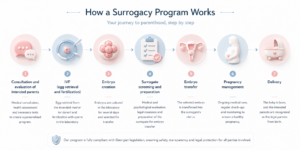
If, after evaluation, surrogacy is a good fit for the intended parents, the program moves forward in several steps.
The steps include: consultation and evaluation of the intended parents, IVF and embryo creation, screening and preparing the gestational carrier, embryo transfer, prenatal care, and childbirth.
Who Can Become a Gestational Carrier?
A gestational carrier is a woman who carries a pregnancy to term after an embryo transfer, but she is not the genetic parent of the baby.
According to ASRM recommendations, it is best if a potential gestational carrier has already had at least one full-term pregnancy without serious problems. She will also have medical, infectious disease, and psychological evaluations.
Choosing a gestational surrogate is more than just picking someone. Before the embryo transfer, it is important to make sure she meets the medical requirements and understands the details of the program.
Why Do Intended Parents Consider Georgia for Surrogacy?
For intended parents, both the medical aspects and the conditions of the program matter. Georgia is popular because it offers full reproductive care and has laws that clearly regulate assisted reproductive technologies and parenthood in these programs.
According to Article 143 of Georgia’s Law “On Health Care”, IVF is permitted, in particular, if a woman lacks a uterus and the embryo is transferred to another woman’s uterus with the couple’s written consent. The law also stipulates that upon the child’s birth, the couple is recognized as the parents, while the donor or surrogate mother is not recognized as the child’s parent.
For international patients, it is especially important to check the current requirements and needed documents ahead of time. Legal rules can change depending on the situation, so it is best to talk about the medical program and legal details before starting treatment.
What Does Silk Medical Offer Prospective Parents?
Silk Medical in Tbilisi offers IVF and surrogacy programs for patients from different countries. Depending on your medical needs, the program may include:
- IVF using the couple’s own eggs;
- programs using donor eggs;
- the use of previously created and frozen embryos;
- embryo cryopreservation;
- genetic testing of embryos when indicated;
- medical care for the gestational carrier;
- legal support.
At Silk Medical, all medical and organizational steps can be managed in one clinic. Patients have access to reproductive specialists, an embryology lab, donor programs, and care during pregnancy. They can also get help with legal and organizational matters.
Key Points to Remember
Surrogacy can help people become parents when carrying a child themselves is not possible or is too risky. Before starting, it is important to understand the medical reasons, look at all options, and check the legal requirements ahead of time.
If you are thinking about surrogacy, it is important to pick a clinic that can support you at every step, from consultation and embryo creation to preparing the gestational carrier, managing the pregnancy, and handling all the details.
Silk Medical in Tbilisi brings together reproductive medicine, embryology, donor programs, and medical support for surrogacy. For international patients, the team helps set up a program that fits their medical needs. You can begin with a consultation with a reproductive specialist to talk about the options for your situation.

 English