



Some couples arrive at the clinic with frozen embryos already in hand. Others are only beginning to consider surrogacy after a string of unsuccessful IVF attempts or years of infertility treatment. This is precisely why timelines are always individual — shaped by the couple’s medical situation, whether embryos exist, and the specifics of their programme.
Georgia has remained one of the most sought-after destinations for international surrogacy, valued for its clear legal framework, programme accessibility, and a process that tends to be predictable. While every situation is unique, most programmes move through broadly similar stages — which makes it possible to sketch out a general timeline with reasonable accuracy.
It All Starts with an Assessment
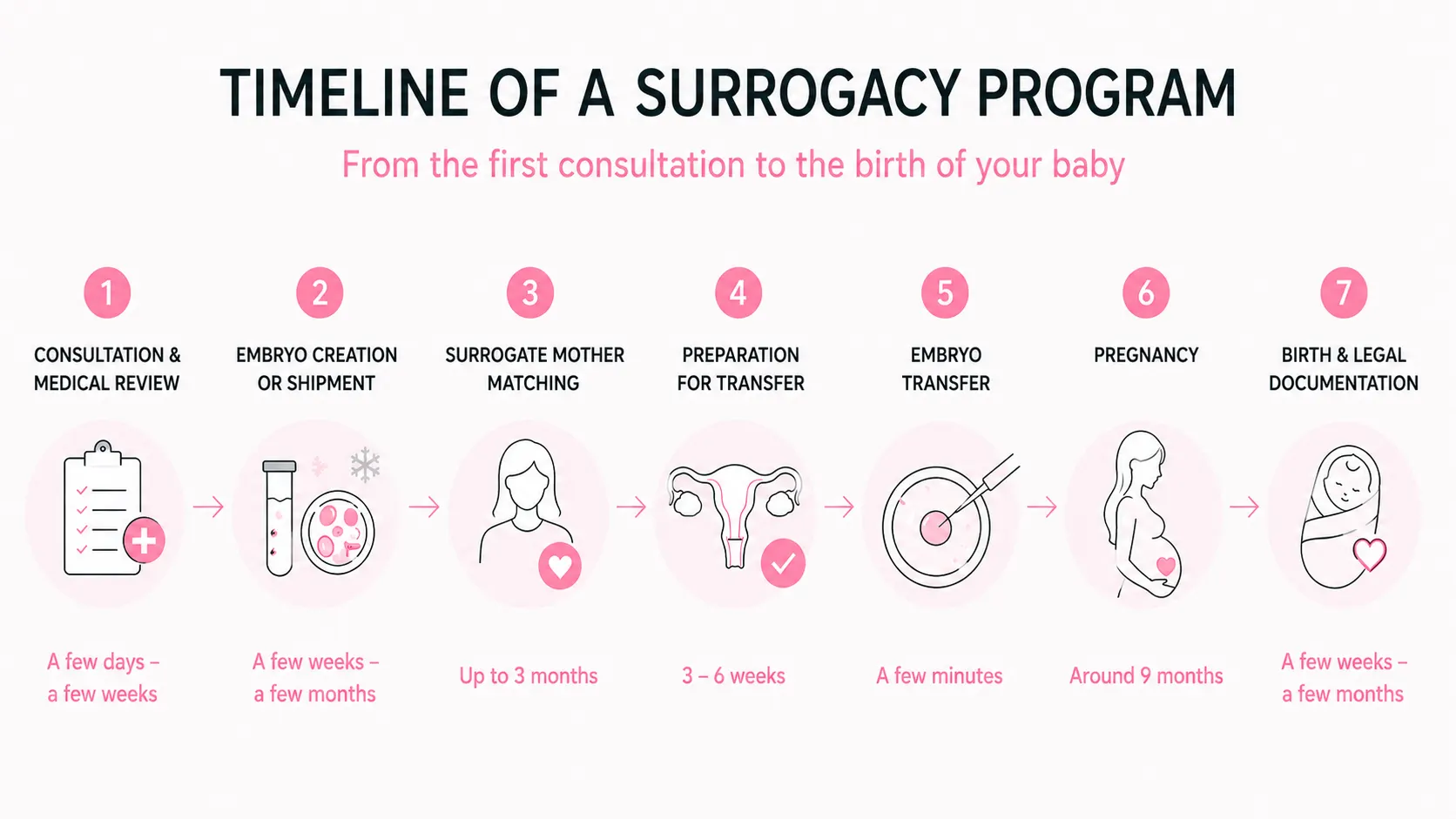
The first step is a specialist consultation and a review of medical records.
At this stage, physicians take stock of the couple’s treatment history, the availability of embryos, and the outcomes of any prior IVF cycles, then map out the most sensible path forward.
For some patients, the programme can get under way almost immediately. For others, additional diagnostic workup — or the creation of embryos — is needed before anything else can begin.
This stage typically takes anywhere from a few days to a few weeks.
Do You Already Have Embryos?
This is one of the factors that most significantly affects the overall timeline.
If embryos have already been created and are in storage, the programme can move considerably faster. In some cases, embryos can be safely transported to Georgia from abroad.
If no embryos exist yet, an IVF cycle will be required. Some patients use their own eggs; others explore donor programmes or opt for preimplantation genetic testing (PGT) before transfer.
Depending on the programme, this phase can stretch from a few weeks to several months.
Selecting a Surrogate
Once the embryos are in place, attention turns to finding the right match. At SILK Medical, every candidate is put through a thorough medical workup — her obstetric history is reviewed, her current health is assessed, and her fit for the programme is carefully weighed. Only women who have carried at least one healthy pregnancy to term and who meet the clinic’s clinical criteria make it into the database.
That process takes up to three months on average, though it can run shorter or longer depending on the situation.
Preparing for Embryo Transfer
With a surrogate confirmed, the groundwork for the transfer begins. Specialists track the endometrial lining and hormonal profile to find the right moment — the transfer itself is over in minutes, but arriving at that point takes several weeks of deliberate preparation.
Pregnancy
Following the transfer comes the longest stage of the programme.
A pregnancy test is performed a few days later. If the result is positive, routine monitoring of the pregnancy begins.
The surrogate is followed closely from the first trimester to the last, and intended parents stay in the loop throughout — not just at the major milestones, but as the pregnancy unfolds week by week. Like any pregnancy, this stage takes approximately nine months.
What Happens After the Baby Is Born?
For many international patients, this phase raises just as many questions as the programme itself.
Part of what draws international patients to Georgia is a legal system that doesn’t leave much to interpretation. Under current legislation, intended parents are recognised as the child’s legal parents from birth and are named directly on the birth certificate.
After delivery, the process of obtaining the documentation needed for the family to travel home begins. The specific timeline depends on the requirements of the parents’ home country and the pace of the relevant embassy.
Do You Need to Be in Georgia Throughout the Programme?
No. In most cases, intended parents are not required to be present in Georgia for the duration of the programme.
The number of trips depends on the chosen programme, whether IVF or embryo creation is needed, and the legal procedures involved. Many patients travel for the key milestones, while the rest of the process is coordinated remotely with the clinic’s team.
After the birth, parents typically need to remain in the country until all documentation has been completed and exit clearance obtained in line with their home country’s requirements.
So, How Long Does the Whole Journey Take?
If embryos are already in place and the programme moves without complications, the path from first consultation to birth typically spans around 12 to 15 months.
Couples who still need IVF, genetic testing, or who go through more than one transfer should count on a longer road. Surrogacy moves in layers, each one building on the last — and knowing that from the start is, arguably, the most useful thing a prospective parent can bring to the process.
Why Do So Many Couples Choose Georgia for Surrogacy?
When choosing a country for surrogacy, medical technology is only part of the picture. Intended parents also want to understand the rules that govern the process, how long the programme is likely to take, and what kind of support they can expect at each stage.
For many years, Georgia has stood out as a leading destination for international surrogacy programmes, bringing together modern reproductive medicine, a transparent legal system, and costs that compare favourably with much of Europe and the United States.
An additional draw is the ability to move through the entire journey within a single integrated programme — from creating or transporting embryos to the birth of the child and the completion of all required documentation.
At SILK Medical, intended parents are supported at every stage of the programme. The clinic’s team helps coordinate the medical, organisational, and legal aspects of the process, so that patients can direct their energy toward what matters most — preparing for the arrival of their child.

 English