



If you are planning IVF in another country, it helps to think ahead about each step. Consider when to start preparing, which tests to do before you travel, how long you will need to stay at the clinic, and if you might need to return for a second visit.
At Silk Medical, you can start preparing for your treatment before you arrive in Georgia. International patients send their medical records and test results ahead of time, so our fertility specialist can review your case and create a personal treatment plan.
This article explains how IVF at Silk Medical works for international patients, how long you might need to stay in Tbilisi, and ways to shorten your visit.
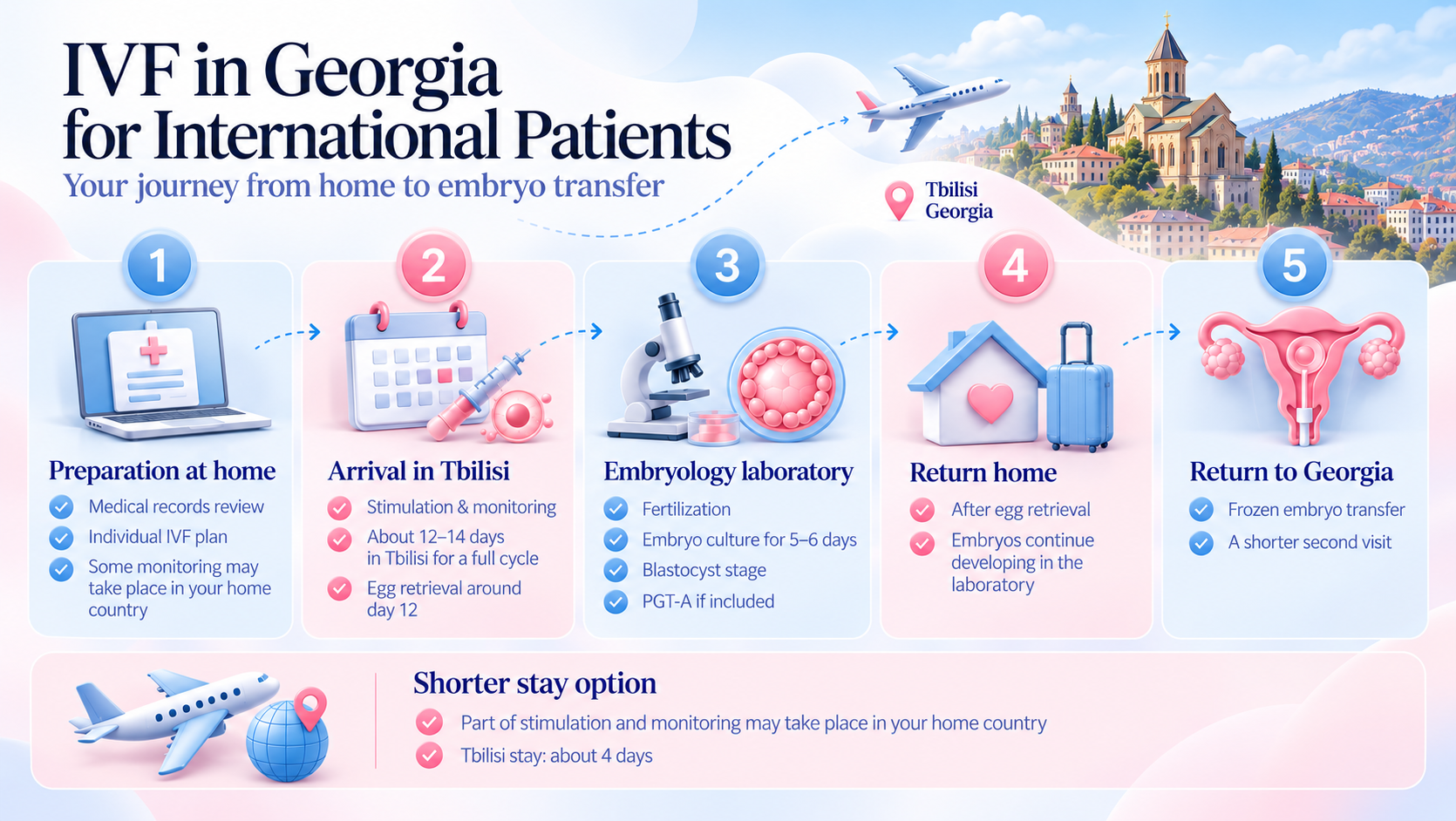
Preparation at home
Planning your IVF program begins before you travel to Georgia. At this point, the fertility specialist looks at your completed test results and lets you know if any other tests are needed.
You and your doctor will agree on the stimulation plan, monitoring dates, and a rough travel schedule before you arrive. If your program allows, you can do part of the stimulation and monitoring in your home country and send the results to the Silk Medical team.
You can read more about the required workup in the article “What tests are needed before IVF?”
Arrival in Tbilisi — stimulation and monitoring
If you are using your own eggs, a full IVF cycle usually takes about 12 to 14 days in Tbilisi. The exact length depends on your treatment plan and how your body responds to stimulation.
Your trip is planned to start at the beginning of your menstrual cycle. Stimulation usually starts on day two and lasts about ten days. During this time, you will visit the clinic every few days for ultrasound scans and hormone checks. If you are in Tbilisi for stimulation, the clinic can give you the necessary injections.
Egg retrieval usually happens around day 12. This is a short procedure done under anaesthesia, and most people can leave the clinic the same day. If your partner’s sperm is being used, their sample is collected at this time. The details for providing a sample depend on your program and are planned ahead of time.
After egg retrieval, the main part of your stay in Tbilisi is finished, and the next steps take place in the embryology lab.
Embryology laboratory — embryo development
After the eggs are retrieved, they are fertilised and the embryos develop in the laboratory. This process usually takes about 5 to 6 days, until the embryos reach the blastocyst stage.
If your program includes PGT-A, an embryo biopsy is done at the blastocyst stage. The embryos are then frozen and kept safe until the genetic test results are ready.
You do not need to stay in Georgia during the laboratory stage. After egg retrieval, you can go home while your embryos develop and, if needed, have a biopsy and be frozen. You can read more about the first five days of embryo development in the article “Five days in the life of an embryo: what happens after fertilisation?”
Return to Georgia — embryo transfer
If the embryo transfer does not happen in the same cycle, it will be scheduled later, after your endometrium is ready.
You can prepare your endometrium in your home country with your local doctor. Once you are ready, you travel to Tbilisi for the embryo transfer. Silk Medical offers frozen embryo transfer programs, which make travel planning more flexible.
With this approach, your first trip is for stimulation and egg retrieval, and the embryo transfer happens during a separate, shorter visit.
How to shorten the stay in Tbilisi
Sometimes, you can do part of the stimulation and monitoring in your own country. Whether this is possible, and how long your trip will be, depends on your treatment plan, your test results, and what tests are available before you come to Georgia.
If this option works for you, stimulation starts in your home country according to the agreed plan. You will have ultrasound scans and other tests at a local clinic, and the results will help plan the next steps.
You then travel to Tbilisi near the end of the stimulation phase. When you arrive, you will have final monitoring, get the trigger injection for egg maturation, have the egg retrieval, and your partner’s sperm sample will be collected.
With this plan, your stay in Tbilisi can sometimes be as short as four days, but the exact length depends on your treatment plan and test results.
IVF with donor eggs
If you use donor eggs, the program works a bit differently. First, a donor is chosen, and their cycle is matched with your treatment plan. If you use fresh donor eggs, the donor goes through stimulation and retrieval while you get ready for the embryo transfer.
Silk Medical has programs with both fresh and frozen donor eggs.
If you are thinking about this option, it is best to discuss the schedule and timeline with your fertility specialist ahead of time, since they depend on your program and finding the right donor.
IVF and surrogacy
If your IVF is part of a surrogacy program, embryos are created first and then transferred to the surrogate later. If needed, the embryos can be tested and frozen.
The next step is to prepare the surrogate and transfer the embryo. Eligibility for international patients, program terms, and required documents depend on your situation and the rules that apply.
You can read more about the timeline and stages of the program in the article “How Long Does Surrogacy Take — From First Consultation to Birth?”
Cost of IVF programs
Silk Medical offers IVF as bundled programs, so you know ahead of time which key stages are included in your chosen option.
Prices are current as of 24 September 2026.
IVF with own eggs costs $6,000 for a full IVF cycle with one embryo transfer, or $7,000 for a program with PGT-A covering up to five embryos and one frozen embryo transfer.
IVF programs with donor eggs range from $6,500 to $10,000, depending on the option chosen, the number of embryos, genetic testing, and the number of transfers. Donor compensation is paid separately and ranges from $2,000 to $4,500.
If you are planning IVF in Georgia, you can send your medical records to Silk Medical before you travel. Our fertility specialist will review your case, help you choose the right program, and make a plan for your trip.

 English